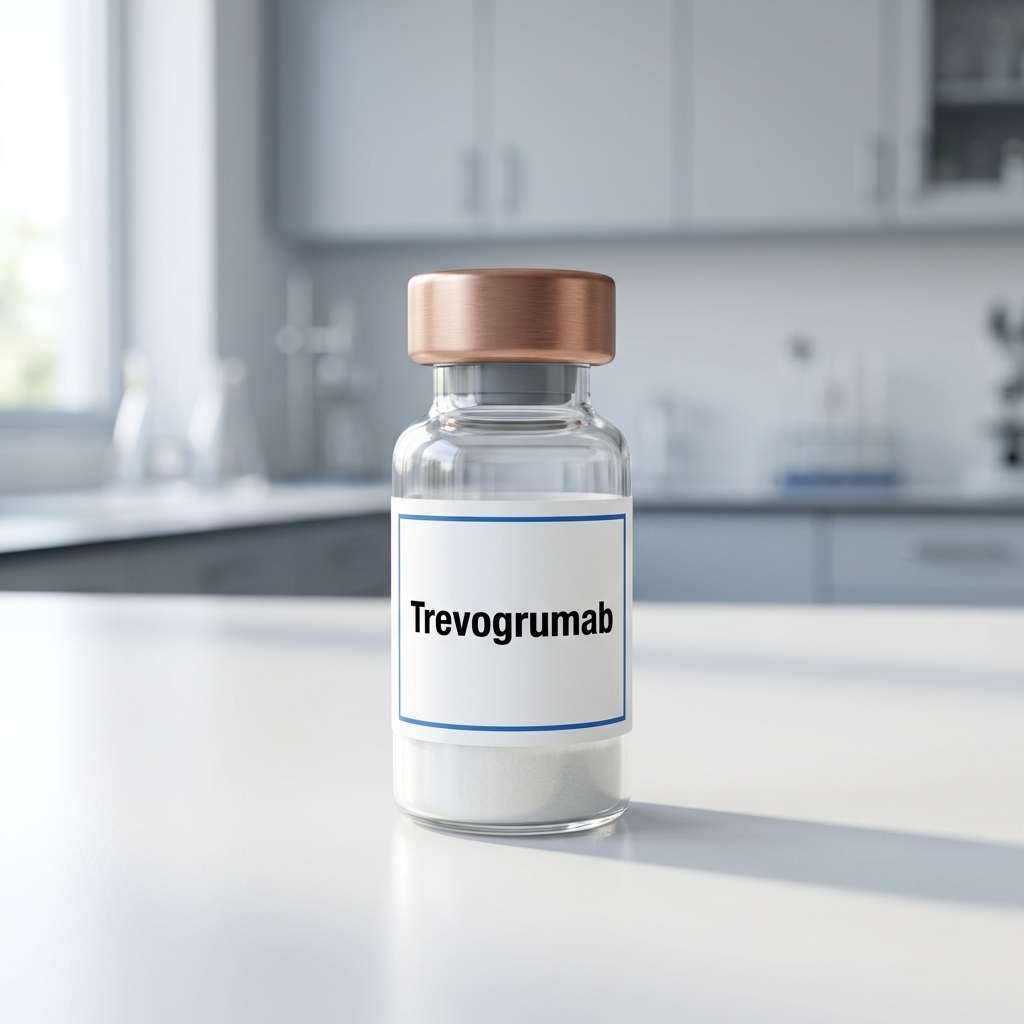
Trevogrumab
Trevogrumab (REGN1033) is a fully human anti-myostatin (GDF-8) IgG4 monoclonal antibody, CHO-expressed, for muscle biology research. Does not cross-react with GDF11. Sold per vial, 0.1mg to 100mg.
Volume pricing
Per-kit price drops as you scaleAdd 1 more kit
Unlock Lab pricing at $635/kit
extra savings
Free Worldwide Shipping
No minimum order. Customs handled.
Express Delivery
7-14 Days
Ships To
190+ Countries
Customs Handled
99% Success Rate
Stealth Packaging
Cold-Chain
Lab-Grade Guarantee
If an independent HPLC assay of your lot comes back below the purity stated on our published Certificate of Analysis, we reship your order free. Verifiable, not a promise.
99.1% Purity Verified
SEC-HPLC / SDS-PAGE / Intact Mass / ELISA Tested
FOR RESEARCH PURPOSES ONLY. This product is strictly for laboratory and research use. Not for human consumption, medical treatment, or any clinical application. By ordering, you confirm you are a qualified researcher or represent a legitimate research institution.
Trevogrumab: Key Facts
Trevogrumab is a muscle growth research peptide supplied by LyzeLabs as a lyophilized reference standard, strictly for laboratory research use. It is available in 5 formats. Each batch is independently HPLC-verified at 99.1% purity by Janoshik Analytical, with the certificate of analysis published on the lab-results page and matched to the lot number printed on the vial.
| Compound | Trevogrumab |
|---|---|
| Research category | Muscle Growth |
| Available formats | 0.1mg x 1 vial, 1mg x 1 vial, 5mg x 1 vial, 10mg x 1 vial, 100mg x 1 vial |
| Purity | 99.1% verified (third-party HPLC, Janoshik) |
| Test method | SEC-HPLC / SDS-PAGE / Intact Mass / ELISA |
| Certificate of analysis | Published online, matched to the vial lot number |
| Intended use | Laboratory research use only. Not for human consumption. |
| Handling | Supplied lyophilized, store per the stability guide |
Independent research lab
United States
"Ordered the 1mg for a myostatin neutralisation assay. SEC trace on the certificate matched what we measured in-house, monomer just over 99 percent. Good to see a vendor that does not call this a peptide."
2026-08-06
Daniel K.
Germany
"Arrived cold and intact in 11 days. Reconstituted clear, no visible particulates."
2026-08-04
Independent testing lab
United Kingdom
"The GDF11 counter-screen row on the COA is the reason we bought here rather than a decoy receptor. Batch number on the vial matched the certificate online."
2026-08-01
About This Product
Trevogrumab (REGN1033) Research Guide
What is Trevogrumab?
Trevogrumab is a fully human IgG4-kappa monoclonal antibody that binds and neutralises myostatin, also called growth differentiation factor 8 or GDF-8. Its development code is REGN1033. It was generated by Regeneron on the VelocImmune platform, with Sanofi as a development partner, and it is in Phase 2 clinical investigation in the COURAGE trial (NCT06299098) combined with semaglutide for lean mass preservation during weight loss.
Key identifiers: CAS 1429201-24-0, molecular formula C6374H9884N1696O2018S46, molar mass 144,037.80 g/mol, roughly 144 kDa. Expressed in Chinese hamster ovary cells and purified by Protein A affinity chromatography.
Trevogrumab is not a peptide. It is a four-chain antibody about thirty times the mass of a peptide like BPC-157, with two heavy chains, two light chains, interchain disulfide bonds and N-linked glycosylation. Solid-phase peptide synthesis cannot produce it. Several vendors list it under "peptides" anyway; that labelling is wrong and it changes how the material must be tested, stored and handled.
How does Trevogrumab work?
Myostatin is the principal negative regulator of skeletal muscle mass. It is secreted by myocytes, circulates as a latent complex, and signals through the activin type IIB receptor (ActRIIB) paired with ALK4 or ALK5, driving SMAD2 and SMAD3 phosphorylation and restraining muscle protein synthesis.
Trevogrumab is a ligand trap. It binds myostatin in the extracellular space and prevents it engaging ActRIIB, rather than blocking the receptor itself.
- Binds all three forms: mature myostatin, the latent complex, and the pro-form
- Does not cross-react with GDF11, despite roughly 90 percent mature-domain identity
- IgG4 backbone: minimal Fc effector function, so a neutralising antibody does not also recruit antibody-dependent cytotoxicity
- Ligand trap, not receptor blocker: leaves ActRIIB free for its other ligands, which is a cleaner design when the study variable is myostatin specifically
Why does the GDF11 selectivity matter?
Most myostatin tools cannot tell myostatin and GDF11 apart. A soluble ActRIIB-Fc decoy binds myostatin, GDF11, activin A and several BMPs at once, so any phenotype it produces is the sum of all of them and no downstream analysis separates the contributions afterwards.
An antibody selective for myostatin over GDF11 lets a research model attribute an effect to one ligand. If a study design depends on that attribution, this is the reason to choose Trevogrumab over a decoy receptor construct, and it belongs in the methods section.
What did the COURAGE trial show?
COURAGE (NCT06299098) is Regeneron's Phase 2 study of semaglutide combined with trevogrumab, with or without [Garetosmab](/product/garetosmab). Results were presented at the EASD 2025 Annual Meeting.
The trial first quantified the problem: roughly one third of the weight lost on semaglutide alone was lean mass, not fat.
Change in lean body mass from baseline at 26 weeks:
| Arm | Lean body mass change | | --- | --- | | Semaglutide alone | -6.5% | | Semaglutide + trevogrumab 200 mg | -3.3% | | Semaglutide + trevogrumab 400 mg | -3.8% | | Semaglutide + trevogrumab + garetosmab | -2.0% |
The triplet reached 80.9 percent lean mass preservation and a 27.3 percent increase in fat mass reduction compared with semaglutide alone.
On tolerability, semaglutide plus trevogrumab was generally well tolerated. The triplet combination, which adds garetosmab, had a substantially higher rate of discontinuations for tolerability and other adverse events. Adverse events reported in at least 5 percent of any group included muscle spasms, nausea, constipation, fatigue, diarrhoea, headache, vomiting, gastro-oesophageal reflux, upper respiratory tract infection, nasopharyngitis, urinary tract infection, influenza and COVID-19.
Trevogrumab is investigational. It is not approved as a medicine in any jurisdiction.
How does Trevogrumab compare to bimagrumab and apitegromab?
These are the three antibodies driving myostatin-pathway research in 2026, and they work at different points in the same pathway. Full breakdown in the [myostatin inhibitor comparison guide](/blog/trevogrumab-vs-garetosmab-vs-bimagrumab-vs-apitegromab).
| Antibody | Target | Level | Distinguishing property | | --- | --- | --- | --- | | Trevogrumab | Myostatin (GDF-8) | Ligand | Binds mature, latent and pro-forms; no GDF11 cross-reactivity | | Garetosmab | Activin A, AB, AC | Ligand | Does not bind activin B, inhibin A, BMP-2/6/9/10, GDF8, GDF11 | | Bimagrumab | ActRIIA / ActRIIB | Receptor | Blocks the whole receptor, so myostatin and activin A together | | Apitegromab | Pro- and latent myostatin | Ligand precursor | Ignores mature myostatin entirely, the narrowest window of the four |
The practical difference: a receptor blocker produces the largest effect and the least attribution, a ligand trap produces a smaller effect you can actually assign to one ligand. In BELIEVE, bimagrumab at 30 mg/kg produced a 2.5 percent increase in lean mass where semaglutide 2.4 mg alone produced a 7.4 percent loss.
Research applications
- Myostatin and GDF-8 pathway pharmacology in skeletal muscle models
- SMAD2 and SMAD3 signalling studies requiring selective ligand neutralisation
- Separating myostatin-driven from GDF11-driven effects, which broad ActRIIB traps cannot do
- Lean mass preservation research alongside incretin agonists such as [Semaglutide](/product/semaglutide), [Tirzepatide](/product/tirzepatide) and [Retatrutide](/product/retatrutide)
- Paired work with [Garetosmab](/product/garetosmab) to dissect two TGF-beta superfamily ligands in one model
- Comparative work against growth-factor-driven approaches such as [IGF-1 LR3](/product/igf-1lr3) and [PEG-MGF](/product/peg-mgf), which stimulate anabolic signalling rather than removing a brake on it
- Antibody handling, formulation and stability method development
How is an antibody tested differently from a peptide?
This is where most listings for this compound fall down, so it is worth reading before comparing certificates.
A peptide certificate is built on reversed-phase HPLC purity, an ESI-MS charge state and Karl Fischer water content. None of those are valid for a 144 kDa glycoprotein. Reversed-phase conditions denature the antibody, a single-charge-state mass is meaningless against a glycan-heterogeneous population, and water content says nothing about the impurities that matter.
The antibody panel replaces it:
| Attribute | Method | Why it exists | | --- | --- | --- | | Monomer purity | SEC-HPLC | Aggregation is the primary quality risk for an antibody | | Aggregate content | SEC-HPLC | Quantified separately from the monomer peak | | Identity and chain integrity | SDS-PAGE, reduced and non-reduced | ~150 kDa intact; ~50 kDa heavy and ~25 kDa light on reduction | | Identity | Deglycosylated intact mass | The mass check that works on a glycosylated protein | | Binding activity | ELISA against immobilised target | An antibody that is pure but not active is a failed lot | | Selectivity | Counter-screen against the lookalike ligand | The property the compound is bought for | | Endotoxin | LAL | Mammalian cell culture product | | Concentration | UV A280 | Reported, not assumed |
If a supplier hands you a reversed-phase HPLC trace and a Karl Fischer number for a monoclonal antibody, that certificate was written for a different kind of molecule.
Handling and storage
Antibodies fail differently from peptides. The dominant failure mode is aggregation, driven by agitation, freeze-thaw cycling and air-liquid interface exposure, not the hydrolysis and oxidation that degrade peptides.
- Lyophilized, unopened: 2 to 8 degrees Celsius, 24 months
- Reconstitute gently: add diluent down the vial wall and swirl. Never vortex, never shake. Foaming denatures antibody at the air-liquid interface
- Reconstituted: 2 to 8 degrees Celsius up to 4 weeks, or single-use aliquots at minus 80 degrees Celsius
- Aliquot before freezing: repeated freeze-thaw is the single largest driver of aggregate formation
Quality standards
- Monomer purity: 98 percent or greater by SEC-HPLC, aggregates reported separately
- Expression system: CHO mammalian cell culture, Protein A purified
- Endotoxin: less than 1.0 EU/mg by LAL
- Form: lyophilized from a histidine and sucrose matrix in single-use vials
- Documentation: batch-matched antibody Certificate of Analysis published at /lab-results
- Fill strengths: 0.1 mg, 1 mg, 5 mg, 10 mg and 100 mg, priced per vial
For laboratory research purposes only. Not for human consumption, therapeutic use, or any in vivo application in humans. Trevogrumab is an investigational compound and is not approved as a medicine in any jurisdiction.
Research Context for Trevogrumab
Muscle Growth and Anabolic Research Context
Muscle growth research peptides study protein synthesis kinetics, satellite cell activation, hyperplasia versus hypertrophy pathways, and the balance of anabolic versus catabolic signaling under controlled conditions. These protocols often involve combination work with growth hormone secretagogues or IGF analogs to probe mechanistic independence.
Trevogrumab ships as a lyophilized research reagent through the LyzeLabs™ catalog in the Muscle Growth category, with 5 variant options sized to different research protocols. Every batch is independently verified by Janoshik Analytical, with the full HPLC chromatogram and mass spectrometry confirmation on this batch's Certificate of Analysis and matched to the lot number printed on your vial. Every released batch is listed on the lab results page.
Related Research Guides
Other Compounds in the Muscle Growth Category
Frequently Asked Questions
Trevogrumab
$720