Comparisons
Ipamorelin vs GHRP-2 vs GHRP-6 vs Hexarelin: Four Growth Hormone Releasers Compared
Ipamorelin, GHRP-2, GHRP-6 and hexarelin all release growth hormone through the ghrelin receptor. They differ in what else they raise: cortisol, prolactin and appetite. Here is how to choose.
LyzeLabs Research Team · Updated · 5 min read
In this guide
Ipamorelin, GHRP-2, GHRP-6 and hexarelin belong to one family: growth hormone releasing peptides, or GHRPs. All four act on the ghrelin receptor and release a burst of growth hormone. What sets them apart is what else they release. In animal tests, ipamorelin raised growth hormone without raising cortisol. GHRP-2, GHRP-6 and hexarelin also raise cortisol and ACTH, the hormone that triggers it, and GHRP-6 strongly drives hunger.
The Short Answer
- Ipamorelin is the selective one. In pigs, it released about as much growth hormone as GHRP-6, without raising ACTH or cortisol, even at more than 200 times the amount needed for growth hormone (Raun, 1998).
- GHRP-2 worked at the smallest amount of the three tested in pigs, though its peak was lower. In Japan, a GHRP-2 test is used to diagnose adult growth hormone deficiency (Fukuda, 2014).
- GHRP-6 is the classic. It releases growth hormone strongly and makes animals eat: it got well-fed rats eating again (Locke, 1995).
- Hexarelin is a powerful releaser that also raises prolactin, ACTH and cortisol in people (Arvat, 1997). Over 16 weeks of twice-daily administration, its growth hormone response fell by almost half, then came back after a 4-week break (Rahim, 1998).
How They Work
Ghrelin is the body's hunger hormone, made mostly in the stomach. GHRPs were made in the lab before ghrelin was discovered; ghrelin was later found to be the natural key to their receptor (Lawrence, 2002). That receptor sits on the pituitary and in the brain's appetite centers, which is why one family can release growth hormone and drive hunger.
GHRPs release growth hormone in two ways at once: they boost the brain's own GHRH signal, and they block somatostatin, the brake on growth hormone (Ghigo, 2001). That is why they are often studied with a GHRH analog such as CJC-1295.
The differences come from what else each one switches on:
- Cortisol and ACTH (the stress hormones): raised by GHRP-2 and GHRP-6 in pigs, and by hexarelin in people. Ipamorelin did not raise them (Raun, 1998).
- Prolactin: GHRPs as a group raise it slightly in people (Ghigo, 2001). Hexarelin's rise is well measured (Arvat, 1997).
- Hunger: GHRP-6 and ghrelin both made rats eat and switched on the brain's appetite centers (Lawrence, 2002).
- The heart: hexarelin also binds CD36, a receptor in heart muscle and blood vessels, and changed blood flow in rat hearts through it (Bodart, 2002).
Side-by-Side Comparison
| Feature | Ipamorelin | GHRP-2 | GHRP-6 | Hexarelin |
|---|---|---|---|---|
| Length | 5 amino acids | 6 amino acids | 6 amino acids | 6 amino acids |
| Main receptor | Ghrelin receptor | Ghrelin receptor | Ghrelin receptor | Ghrelin receptor, plus CD36 in the heart |
| Growth hormone release | Strong, similar to GHRP-6 | Works at the smallest amount | Strong | Powerful |
| Raises ACTH and cortisol | No (pig studies) | Yes | Yes | Yes |
| Best known for | Selectivity | Diagnostic test in Japan | Hunger | Power, and fading with long use |
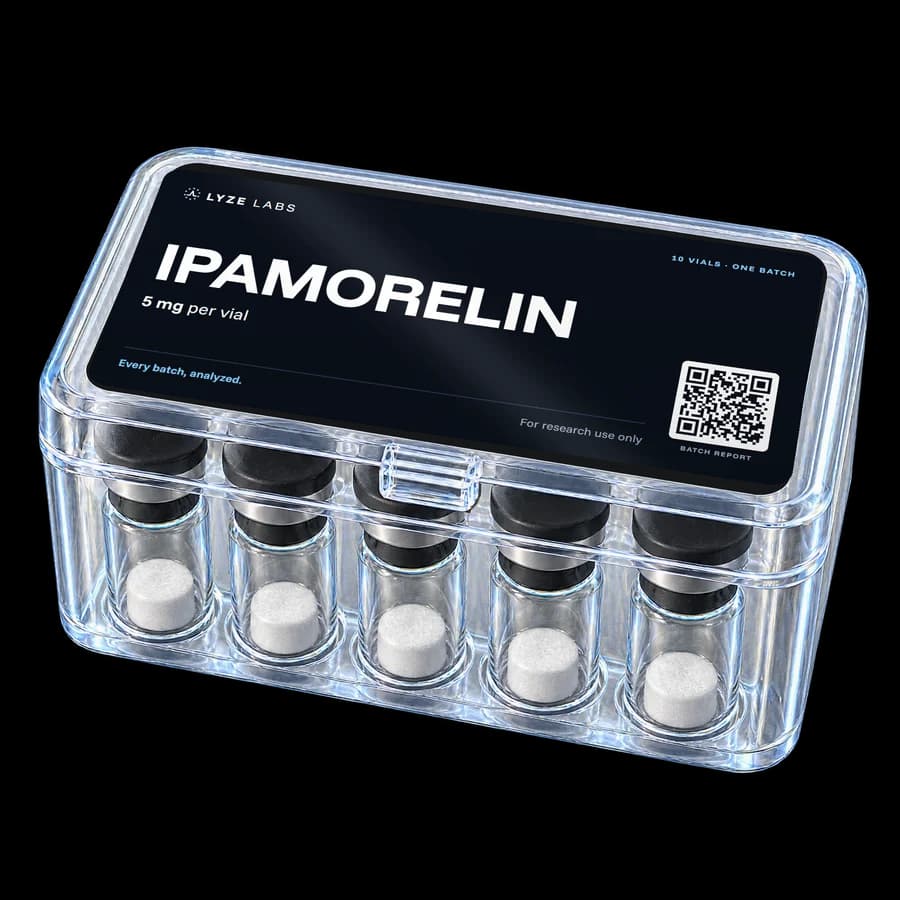
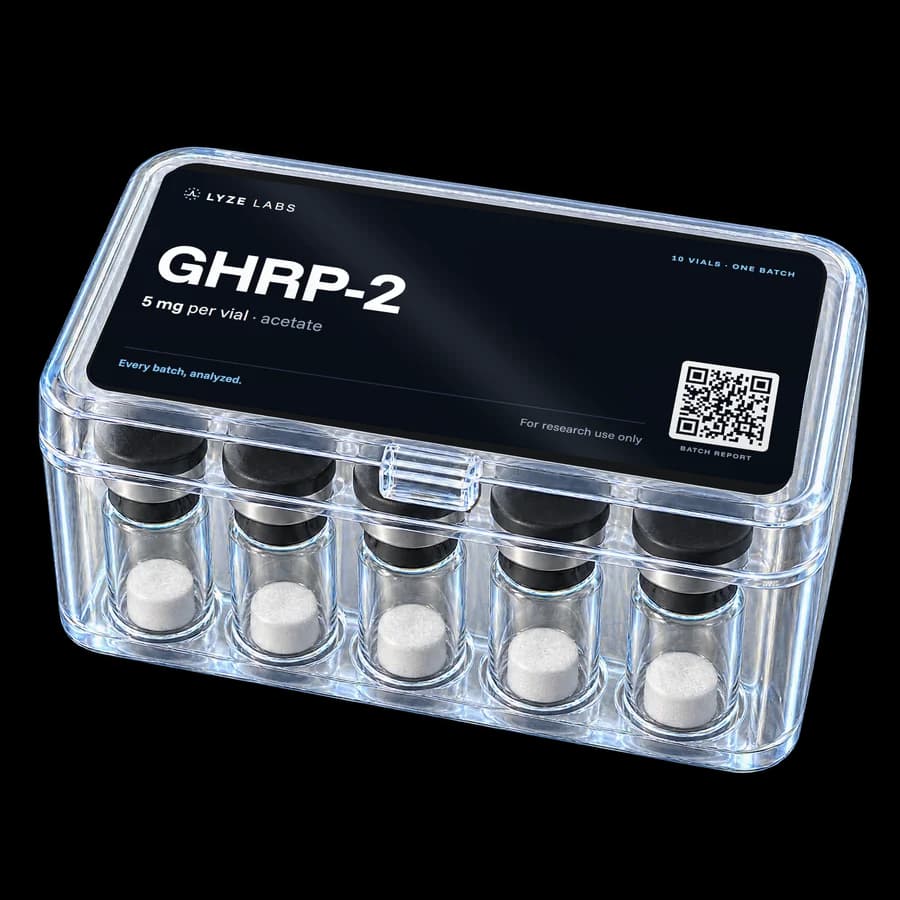
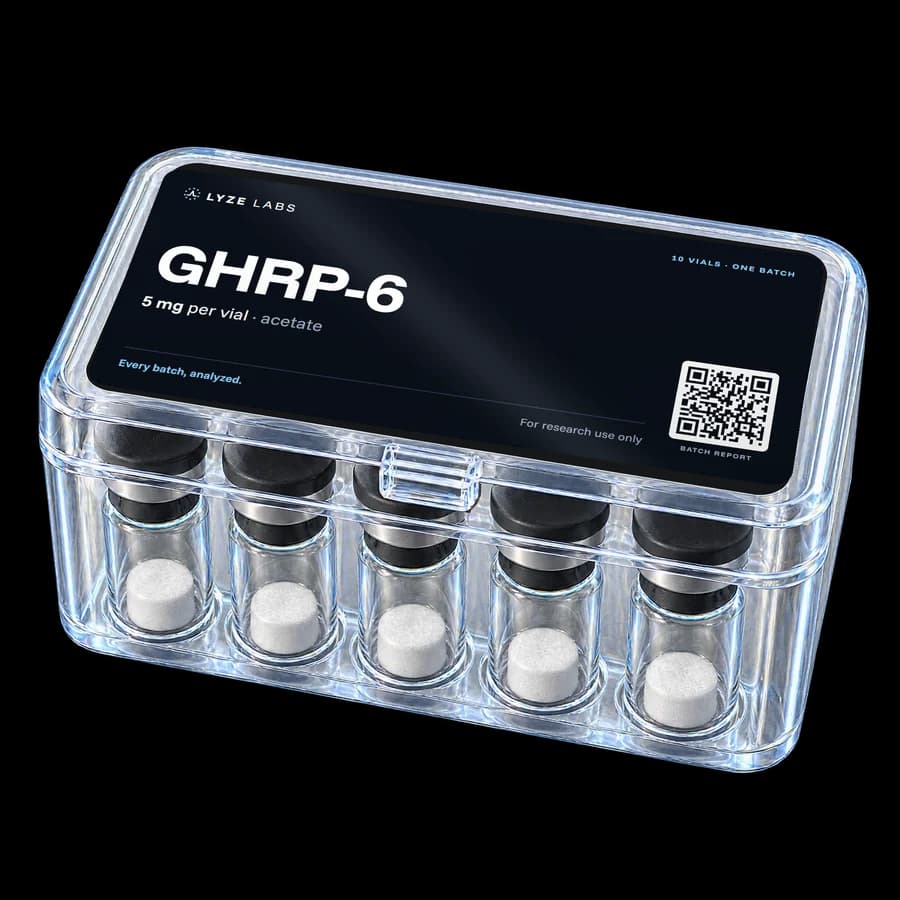
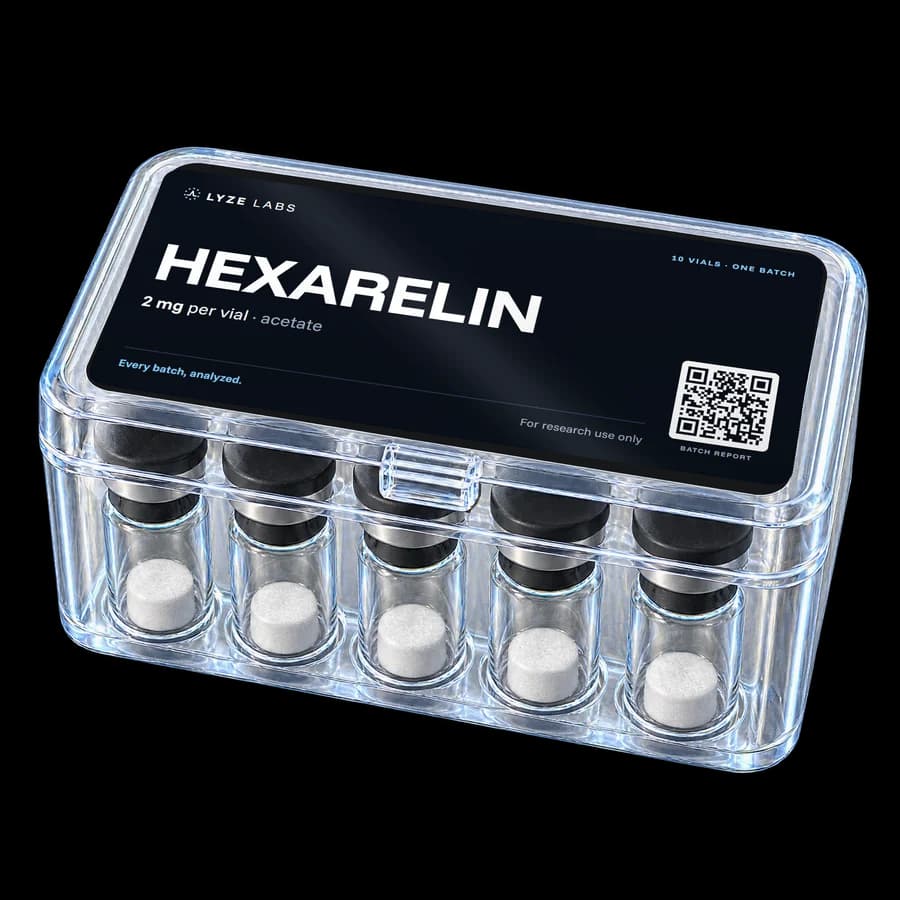
| Our kits | 5 or 10 mg x 10 vials | 5 or 10 mg x 10 vials | 5 or 10 mg x 10 vials | 2 or 5 mg x 10 vials |
Which One Fits Which Research Question?
Choose ipamorelin when you want growth hormone release without the cortisol rise. It is the cleanest tool for isolating the growth hormone effect, and the usual partner in GHRH pairings.
Choose GHRP-2 when you want strong release at small amounts, or you are modeling the growth hormone stimulation test.
Choose GHRP-6 when hunger and feeding are part of the question, or you want the classic member of the family.
Choose hexarelin when you want a powerful release, or you are studying its heart effects through CD36, or how the response fades and recovers with long use.
All four come as ten-vial kits: ipamorelin, GHRP-2, GHRP-6 and hexarelin. The CJC-1295 and Ipamorelin blend pairs ipamorelin with a GHRH analog in one vial.
Handling Differences
All four arrive as freeze-dried powder and mix with bacteriostatic water. They are short peptides of similar size, so the math is the same for each. Keep mixed vials in the fridge. See how to reconstitute research peptides and the storage guide.
Frequently Asked Questions
What is the difference between ipamorelin and GHRP-6?
Both release growth hormone through the ghrelin receptor, about equally well in animal tests. GHRP-6 also raised ACTH and cortisol and strongly drives hunger. Ipamorelin did not raise ACTH or cortisol, even at very high amounts.
Is GHRP-2 stronger than GHRP-6?
In pigs, GHRP-2 worked at a smaller amount than GHRP-6, but its peak growth hormone level was lower. Which one counts as stronger depends on whether you mean potency or peak.
Why does GHRP-6 cause hunger?
It acts on the ghrelin receptor, the same receptor the hunger hormone ghrelin uses. In rats, it switched on the brain's appetite centers and made well-fed animals eat.
Does hexarelin stop working over time?
Partly, and not for good. In 12 healthy older adults, the growth hormone response fell by almost half over 16 weeks, then returned to its starting level 4 weeks after the study ended.
Which GHRP pairs best with CJC-1295?
Ipamorelin is the usual choice, because it adds growth hormone release without the cortisol rise seen with the others.
Studies Cited
- Raun K, et al. (1998). Ipamorelin, the first selective growth hormone secretagogue. European Journal of Endocrinology.
- Fukuda I, et al. (2014). Adult growth hormone deficiency: current concepts. Neurologia Medico-Chirurgica.
- Locke W, et al. (1995). Intracerebroventricular growth-hormone-releasing peptide-6 stimulates eating without affecting plasma growth hormone responses in rats. Life Sciences.
- Lawrence CB, et al. (2002). Acute central ghrelin and GH secretagogues induce feeding and activate brain appetite centers. Endocrinology.
- Arvat E, et al. (1997). The GH, prolactin, ACTH and cortisol responses to Hexarelin, a synthetic hexapeptide, undergo different age-related variations. European Journal of Endocrinology.
- Rahim A, Shalet SM (1998). Does desensitization to hexarelin occur?. Growth Hormone and IGF Research.
- Bodart V, et al. (2002). CD36 mediates the cardiovascular action of growth hormone-releasing peptides in the heart. Circulation Research.
- Ghigo E, et al. (2001). Biologic activities of growth hormone secretagogues in humans. Endocrine.
This guide is for education. It is not medical advice. Every compound we supply is for laboratory research only and is not for human use.