Comparisons
HGH 191AA vs IGF-1 LR3: Upstream Hormone or Downstream Growth Factor?
HGH tells the liver to make IGF-1. IGF-1 LR3 skips that step and acts on the IGF-1 receptor directly. Here is how the two differ, and which one fits which research question.
LyzeLabs Research Team · Updated · 6 min read
In this guide
HGH 191AA and IGF-1 LR3 are often treated as two versions of the same thing. They are not. HGH (somatropin) is the hormone; IGF-1 is one of the main things it makes the body produce. HGH acts on the growth hormone receptor, mostly in the liver, which then releases IGF-1. IGF-1 LR3 skips that step and acts directly on the IGF-1 receptor.
That one difference, upstream against downstream, decides how each behaves in research. This guide covers what each is, how they differ, and which fits which question.
The Short Answer
- HGH 191AA is the full 191-amino-acid human growth hormone (about 22 kDa). It works through the growth hormone receptor. Many of its growth effects run through the IGF-1 it triggers, but it also has direct effects of its own, such as breaking down fat and raising blood sugar.
- IGF-1 LR3 is a modified IGF-1 of 83 amino acids (about 9.1 kDa). It acts on the IGF-1 receptor directly and escapes the binding proteins that normally trap IGF-1, which made it about 2.5 times as potent as natural IGF-1 in rats (Tomas, 1992). Its effects look more like insulin's, and it can lower blood sugar.
- So HGH is the tool for studying the whole growth hormone system; IGF-1 LR3 is the tool for studying IGF-1 signaling on its own.
How Each One Works
HGH 191AA: the upstream hormone
Growth hormone is released by the pituitary gland in pulses, mostly during sleep. It binds growth hormone receptors throughout the body. In the liver, that makes cells release IGF-1 into the blood; many other tissues, muscle included, also make their own IGF-1 in response.
Growth hormone's effect on body growth depends on IGF-1, but it also does things IGF-1 does not, such as releasing fat from fat tissue (Velloso, 2008). It also works against insulin, which is why high growth hormone tends to raise blood sugar. For the full story of the 191AA sequence, see the HGH 191AA guide.
IGF-1 LR3: the downstream growth factor
IGF-1 binds the IGF-1 receptor, which switches on the PI3K/Akt/mTOR pathway that builds protein and grows cells. In the blood, natural IGF-1 is mostly held by IGF binding proteins, so only a small share is free to act.
IGF-1 LR3 changes two things: the glutamic acid at position 3 becomes arginine, and 13 amino acids are added to the front. Together they make it bind those binding proteins very poorly, so far more of it stays free. For the details, see the IGF-1 LR3 guide.
Side-by-Side Comparison
| Feature | HGH 191AA | IGF-1 LR3 |
|---|---|---|
| What it is | Human growth hormone (somatropin) | Modified IGF-1 |
| Length | 191 amino acids | 83 amino acids |
| Size | ~22 kDa | ~9.1 kDa |
| Receptor | Growth hormone receptor | IGF-1 receptor |
| Place in the system | Upstream: triggers IGF-1 | Downstream: acts like IGF-1 |
| Direct fat breakdown | Yes | Not its main effect |
| Effect on blood sugar | Tends to raise it | Tends to lower it (insulin-like) |
| Binding proteins | Not relevant | Escapes them, so stays free |
| Measured in | IU (1 mg is about 3 IU) | mg or micrograms |
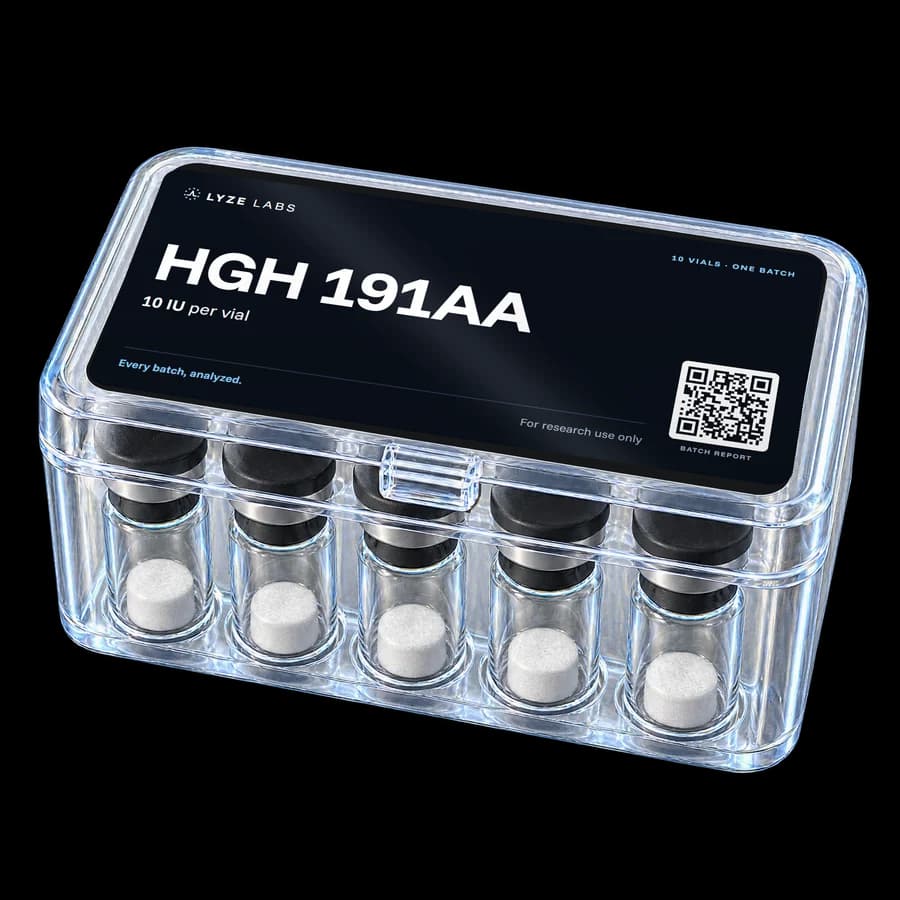
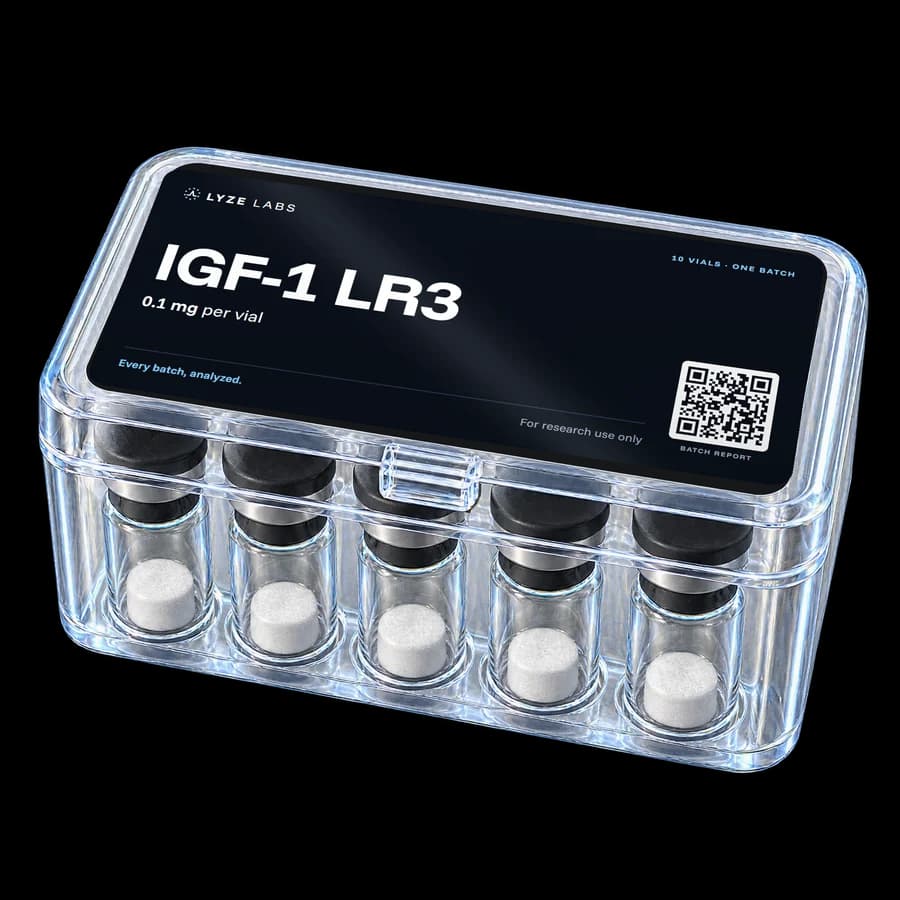
| Our kits | 10, 12, 15, 24, 36 IU x 10 vials | 0.1 mg or 1 mg x 10 vials |
Which One Fits Which Research Question?
Choose HGH 191AA when you want the whole growth hormone system: the pulse, the liver's IGF-1 response, and growth hormone's own direct effects on fat and metabolism. It is also the natural reference when comparing growth hormone releasers such as CJC-1295 or tesamorelin with the hormone itself.
Choose IGF-1 LR3 when you want IGF-1 signaling on its own, without growth hormone's other effects: muscle cell growth in culture, satellite cells, or the IGF-1 receptor pathway. It is the more direct tool for cell work.
Study both when your question is which effects of growth hormone run through IGF-1 and which do not. Running them side by side is the classic way to separate the two.
Both come as ten-vial kits: HGH 191AA in five strengths from 10 to 36 IU, and IGF-1 LR3 in 0.1 mg or 1 mg.
One honest note: a review of the evidence found very little support for the idea that extra growth hormone or IGF-1, above normal levels, builds muscle in healthy individuals, whatever its reputation (Velloso, 2008). Both are research tools for understanding the system.
Handling Differences
HGH is a large protein. It is fragile once mixed: swirl, never shake, keep it in the fridge and use it within a few weeks. Its strength is given in IU, so check how many mg your vial holds (about 3 IU per mg) before doing the math.
IGF-1 LR3 is smaller but still a fragile protein. It comes in microgram amounts, so the math is in micrograms per mL, and it needs the same gentle handling. See how to reconstitute research peptides and the storage guide.
Frequently Asked Questions
Is IGF-1 LR3 the same as HGH?
No. HGH is growth hormone, the 191-amino-acid hormone made by the pituitary. IGF-1 is a different protein that growth hormone makes the liver and other tissues release. IGF-1 LR3 is a modified IGF-1, so it acts one step further down the chain than HGH.
Which is stronger, HGH or IGF-1 LR3?
They do different things, so there is no single answer. IGF-1 LR3 is about 2.5 times as potent as natural IGF-1 at the IGF-1 receptor in rats, because it escapes the binding proteins. HGH has effects IGF-1 LR3 does not, such as direct fat breakdown, and it raises the body's own IGF-1.
Does HGH raise IGF-1?
Yes. That is one of its main effects: growth hormone makes the liver, and many other tissues, release IGF-1. Measuring IGF-1 is the usual way to confirm growth hormone activity in research.
Why does HGH raise blood sugar while IGF-1 lowers it?
Growth hormone works against insulin in the liver and in fat and muscle, which tends to raise blood sugar. IGF-1 is closely related to insulin and its receptor signals in a similar way, so it tends to lower blood sugar. That contrast is one reason researchers study them separately.
Can they be studied together?
Yes, and it is a common design: comparing growth hormone with IGF-1 separates the effects that run through IGF-1 from those that do not.
Studies Cited
- Velloso CP (2008). Regulation of muscle mass by growth hormone and IGF-I. British Journal of Pharmacology.
- Tomas FM, et al. (1992). Insulin-like growth factor-I (IGF-I) and especially IGF-I variants are anabolic in dexamethasone-treated rats. Biochemical Journal.
This guide is for education. It is not medical advice. Every compound we supply is for laboratory research only and is not for human use.