Melanotan 1 vs Melanotan 2: Receptor Selectivity, Pigmentation, and Research Differences
A research-focused comparison of Melanotan 1 (afamelanotide) and Melanotan 2: how MC1R selectivity versus pan-melanocortin binding shapes pigmentation studies, structure, and receptor pharmacology.
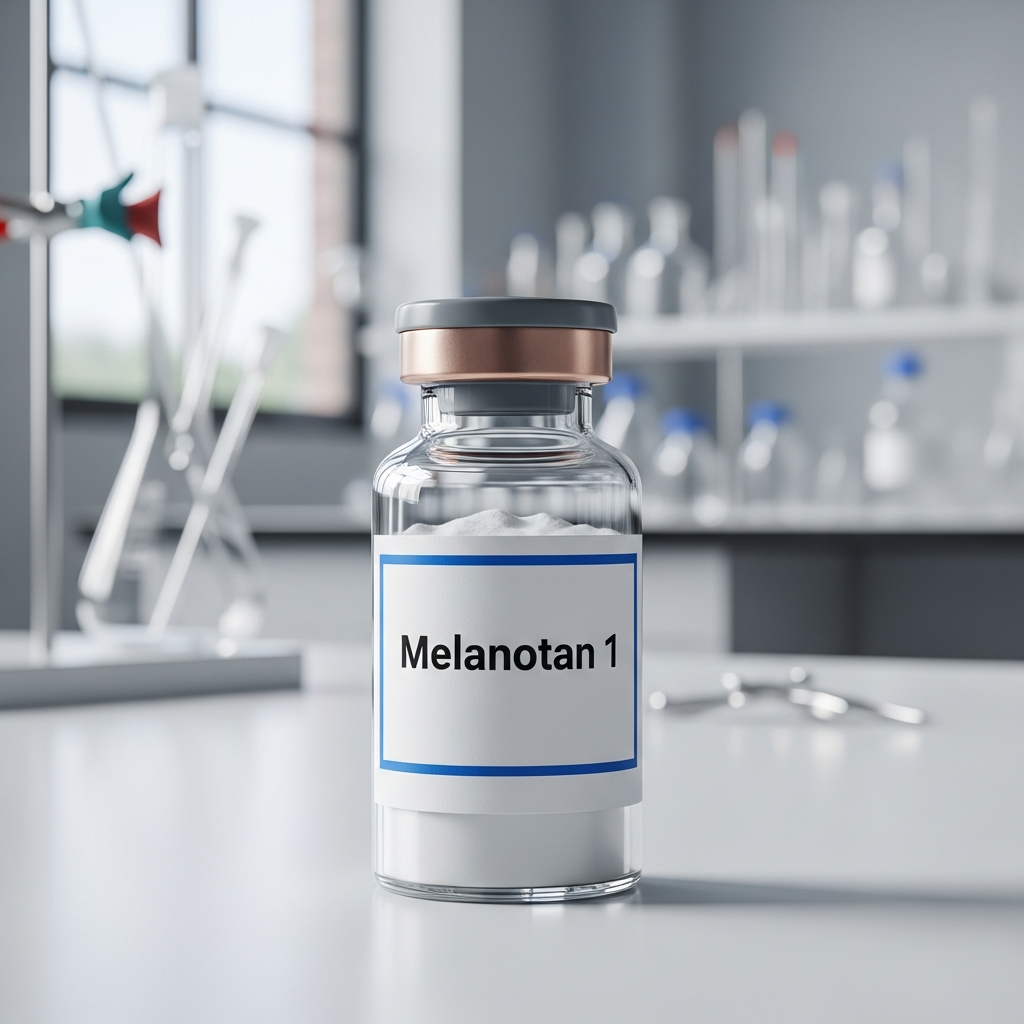
Disclaimer: This article is for educational and informational purposes only. It does not constitute medical advice. All products referenced are intended for research and laboratory use only and are not approved for human consumption.
Ask any researcher comparing melanocortin analogs and the same question surfaces: what is the real difference between Melanotan 1 and Melanotan 2? Both are synthetic analogs of alpha-melanocyte-stimulating hormone (alpha-MSH), both drive melanin synthesis in pigmentation models, and both appear in catalogs side by side. Yet they are distinct molecules with different structures, different receptor selectivity, and very different pharmacological footprints. This guide breaks down Melanotan 1 vs Melanotan 2 for laboratory and research use only, grounded in the published mechanism and chemistry so you can match the right compound to the right experimental question.
Key Takeaways
- Melanotan 1 (afamelanotide) is a linear 13-amino-acid peptide, [Nle4, D-Phe7]-alpha-MSH (NDP-MSH), CAS 75921-69-6, that is highly selective for the MC1R receptor governing pigmentation.
- Melanotan 2 (MT-2) is a cyclic heptapeptide, Ac-Nle-c[Asp-His-D-Phe-Arg-Trp-Lys]-NH2, CAS 121062-08-6, molecular formula C50H69N15O9, molecular weight 1024.18, and a potent pan-melanocortin agonist.
- The core distinction is receptor selectivity: MT-1 is MC1R-focused, while MT-2 also activates MC3R, MC4R, and MC5R, broadening its observed effects in research models.
- In pigmentation research, MT-2 produces faster, more pronounced melanogenesis, while MT-1 produces a cleaner MC1R-specific signal.
- Afamelanotide (MT-1) has a clinical history and is the active molecule in an approved MC1R therapy, whereas MT-2 remains a research-grade compound.
- Both are supplied by Lyze Labs strictly FOR RESEARCH AND LABORATORY USE ONLY, third-party HPLC tested at 99%+ purity with a published COA.
What Melanotan 1 and Melanotan 2 Actually Are
Both peptides trace back to the same parent hormone. Alpha-MSH is an endogenous 13-amino-acid melanocortin that binds melanocortin receptors and, at MC1R, triggers the cascade that produces eumelanin. The problem alpha-MSH presents to researchers is fragility: its plasma half-life is measured in minutes because circulating proteases degrade it almost immediately, which makes the native hormone impractical as a research tool.
Melanotan 1 and Melanotan 2 are two different engineering answers to that fragility. Melanotan 1, assigned the international nonproprietary name afamelanotide, keeps the linear backbone of alpha-MSH but substitutes norleucine at position 4 and D-phenylalanine at position 7. That single D-Phe7 swap increased receptor binding affinity roughly 1,000-fold over the parent hormone and conferred protease resistance, dramatically extending its functional window. Melanotan 2 took a different route entirely: it shortened the chain and closed it into a ring through a lactam bridge, creating a compact, enzyme-resistant cyclic heptapeptide. The cyclization is what makes MT-2 so stable, but it also changed which receptors the molecule prefers.
Melanotan 1 vs Melanotan 2: Side-by-Side Comparison
The table below summarizes the structural and pharmacological differences most relevant to research model design.
| Attribute | Melanotan 1 (Afamelanotide) | Melanotan 2 (MT-2) |
|---|---|---|
| Chemical class | Linear alpha-MSH analog | Cyclic lactam alpha-MSH analog |
| Sequence | Ac-Ser-Tyr-Ser-Nle-Glu-His-D-Phe-Arg-Trp-Gly-Lys-Pro-Val-NH2 | Ac-Nle-c[Asp-His-D-Phe-Arg-Trp-Lys]-NH2 |
| Length | 13 amino acids | 7 amino acids (cyclic) |
| CAS number | 75921-69-6 | 121062-08-6 |
| Molecular formula | C78H111N21O19 | C50H69N15O9 |
| Molecular weight | ~1646.8 g/mol | 1024.18 g/mol |
| Receptor selectivity | MC1R-selective | Pan-melanocortin (MC1R, MC3R, MC4R, MC5R) |
| Pigmentation onset (models) | Slower, gradual | Faster, more pronounced |
| Off-target activity | Minimal | Broad (MC3R/MC4R-mediated) |
| Regulatory history | Active molecule in an approved MC1R therapy | Research-grade only |
Receptor Selectivity: The Core Difference
If you remember one thing from a Melanotan 1 vs 2 comparison, make it receptor selectivity. This is the variable that drives almost every downstream difference researchers observe.
Melanotan 1 (afamelanotide) is a high-selectivity MC1R agonist. MC1R is the melanocortin receptor expressed on melanocytes that controls the eumelanin pathway, so MT-1 behaves like a focused pigmentation probe. It produces robust melanin synthesis with minimal engagement of the centrally expressed MC3R and MC4R receptors. For a researcher who wants to isolate MC1R signaling without confounding melanocortin activity elsewhere, the linear molecule offers a cleaner readout.
Melanotan 2 is the opposite design philosophy. It is a potent full agonist at MC3R and MC4R in addition to MC1R, and it touches MC5R as well. That breadth is exactly why MT-2 is studied across more than pigmentation: melanocortin-4 receptor activity is the documented basis for its observed effects on appetite signaling and sexual-function pathways in animal models, which is also the lineage that led to the development of related MC4R-targeted compounds. In a pigmentation experiment, MT-2's lack of selectivity means the observed phenotype is the sum of several receptor signals, not an MC1R-only signal.
Pigmentation Research: How They Behave
In melanogenesis models, both compounds upregulate the same core machinery: binding the melanocortin receptor activates adenylate cyclase, raises intracellular cAMP, and pushes microphthalmia-associated transcription factor (MITF) expression, which in turn drives tyrosinase and eumelanin production. The endpoint is the same; the kinetics differ.
Melanotan 2's higher potency and broad agonism translate into faster, more visible darkening in research subjects, with pigmentation responses observed on a shorter timeline. Melanotan 1's MC1R-selective profile produces pigmentation more gradually but with a tighter mechanistic story, which is part of why afamelanotide became the candidate carried forward into formal MC1R-directed clinical research for the rare condition erythropoietic protoporphyria, where photoprotective melanin is the therapeutic goal.
If your study is specifically about MC1R-driven photoprotection or the eumelanin pathway in isolation, MT-1 is the mechanistic match. If your study tolerates or requires broad melanocortin engagement and you want a strong, fast pigmentation signal, Melanotan 2 is the more common choice in the literature.
Stability, Handling, and Reconstitution
Both peptides ship lyophilized and require reconstitution with bacteriostatic or sterile water before use in research. The cyclic structure of MT-2 gives it strong resistance to enzymatic degradation, and afamelanotide's Nle4/D-Phe7 modifications give the linear molecule its own protease resistance, so both are far more stable than native alpha-MSH. That said, handling discipline still governs data quality.
Store lyophilized material at minus 20 degrees Celsius, protected from light, and keep reconstituted solution refrigerated with minimal freeze-thaw cycling. For exact ratios and storage windows, our peptide reconstitution guide and peptide storage and stability guide walk through the calculations researchers rely on to keep concentrations accurate across an experimental run. Purity matters here too: a degraded or mislabeled sample makes any Melanotan 1 vs 2 comparison meaningless, which is why batch verification and a published certificate of analysis are non-negotiable.
Verifying Purity Before You Compare
A comparison study is only as trustworthy as the material behind it. Two vials labeled "Melanotan 2" from different sources can differ in actual peptide content, acetate load, and impurity profile, and those differences will quietly distort your results. Reverse-phase HPLC confirms identity and quantifies purity, while mass spectrometry confirms the molecular weight matches the expected 1024.18 for MT-2 or the linear mass for MT-1.
Every Lyze Labs batch is third-party HPLC tested to 99%+ purity with a COA you can review before ordering. If you are new to reading these documents, our guide to verifying research peptide purity and COA explains exactly what to look for, and our research peptide scam red flags breakdown shows the warning signs of suppliers who skip testing. With surging global demand for melanocortin and GLP-1 research compounds, verified batches move quickly, so confirming purity up front protects both your data and your budget.
Why Researchers Order From Lyze Labs
Lyze Labs supplies both melanocortin analogs to a research community of 12,000+ researchers across 150+ countries, with a 4.8 out of 5 rating built on verified reviews. Material is third-party HPLC tested, 99%+ pure, and backed by a published COA with batch-level verification, so the molecule in the vial is the molecule on the label.
Ordering is built for speed and discretion. WhatsApp is the fastest channel and connects you directly with the team, and we also accept Visa, Mastercard, UPI, PayPal, CashApp, bank and wire transfer, and crypto including BTC, USDT, and ETH. Every order ships with FREE discreet worldwide delivery, typically arriving in 7 to 14 days. Because melanocortin demand is climbing and batch availability is limited, securing current batch pricing now locks in both supply and cost.
Frequently Asked Questions
What is the difference between Melanotan 1 and Melanotan 2?
Melanotan 1 (afamelanotide) is a linear 13-amino-acid peptide that is highly selective for the MC1R pigmentation receptor, while Melanotan 2 is a smaller cyclic heptapeptide that activates MC1R, MC3R, MC4R, and MC5R. In practical research terms, MT-1 gives a cleaner MC1R-only pigmentation signal and MT-2 gives a faster, broader melanocortin response. Both are sold strictly for laboratory research use only.
Is Melanotan 1 or Melanotan 2 better for pigmentation research?
It depends on the experimental question. Melanotan 2 typically produces faster and more pronounced melanin responses in research models because it is a more potent, broader agonist, while Melanotan 1 is preferred when a study needs to isolate MC1R signaling without off-target melanocortin activity. Neither is intended for human use.
Why is Melanotan 2 less selective than Melanotan 1?
Melanotan 2 is a cyclic lactam analog whose ring structure broadened its binding profile across the melanocortin receptor family, so it acts as a pan-melanocortin agonist. Melanotan 1 retained the linear alpha-MSH backbone with Nle4 and D-Phe7 substitutions that kept its high selectivity for MC1R while adding stability and binding affinity.
What are the CAS numbers and molecular weights for Melanotan 1 and 2?
Melanotan 1 (afamelanotide) is CAS 75921-69-6 with an approximate molecular weight near 1646.8 g/mol for the linear 13-residue peptide. Melanotan 2 is CAS 121062-08-6, molecular formula C50H69N15O9, with a molecular weight of 1024.18. Always confirm these values against the COA and mass spectrometry data for your specific batch.
How do researchers verify Melanotan purity before a study?
Reverse-phase HPLC quantifies purity and confirms identity, and mass spectrometry confirms the molecular weight matches the expected value for the compound. Reputable suppliers publish a third-party COA for every batch. Lyze Labs material is HPLC tested to 99%+ purity, and you can review the COA before ordering.
How is Melanotan 2 shipped and what payment methods are accepted?
Lyze Labs ships every order with FREE discreet worldwide delivery, typically arriving in 7 to 14 days. The fastest way to order is WhatsApp, and accepted payments include Visa, Mastercard, UPI, PayPal, CashApp, bank and wire transfer, and crypto such as BTC, USDT, and ETH.
Order Research-Grade Melanotan 2
Whether your protocol calls for the MC1R-selective profile of Melanotan 1 or the broad melanocortin activity of Melanotan 2 acetate, Lyze Labs ships third-party HPLC tested, 99%+ pure material with a published COA. Message us on WhatsApp for the fastest response and secure current batch pricing before this batch sells out. For broader context, explore our Melanotan 2 (MT-2) research guide and the full melanocortin research library.
Related Research Guides
Melanotan-2 (MT-2) Research Guide: Melanocortin Pathway and Pigmentation Science
A research-focused guide to Melanotan-2 (MT-2), the non-selective melanocortin agonist used to study melanogenesis and receptor pharmacology. Covers mechanism, key findings, how it compares to Melanotan-1 (afamelanotide), quality verification, and sourcing for global pigmentation researchers.
PT-141 (Bremelanotide): Melanocortin Pathway Research Guide
A research-focused overview of PT-141 (Bremelanotide), the synthetic melanocortin receptor agonist studied for its central action on arousal pathways. Covers MC3R/MC4R mechanism, how it differs from peripheral PDE5 compounds, and what defines laboratory-grade material.

How to Choose a Research Peptide Supplier: The 2026 Verification Checklist
A practical 2026 framework for choosing a research peptide supplier: lot-matched HPLC COAs, mass-spec identity, batch transparency, and the verification steps that separate a legit peptide source from a forged one.