Compound guides
PT-141 (Bremelanotide) Explained: The Peptide That Works in the Brain
PT-141 works on the brain's melanocortin receptors, not on blood flow, which sets it apart from almost everything else in its field. Here is how it works and what the studies found.
Lyze Labs Research Team · Updated · 8 min read
In this guide
- Key Takeaways
- What PT-141 Is and How the Mechanism Works
- Why Researchers Are Interested
- How PT-141 Compares to Peripheral-Acting Alternatives
- Reported Specifications and Physical Profile
- What to Look For in Quality and the COA
- Reconstitution and Storage Notes for Research Settings
- Sourcing PT-141 With Confidence
- Frequently Asked Questions
- Studies Cited
PT-141, or bremelanotide in the scientific literature, stands apart in its research area for one reason: it works in the brain. Most compounds studied for arousal act on blood flow in the body. PT-141 acts upstream, on the melanocortin receptors in the brain itself. That difference is why this ring-shaped peptide of seven amino acids draws so much interest from hormone and brain researchers.
This guide covers how PT-141 works, what the trials found, how it differs from the blood-flow compounds, its specifications, and what to check before you buy it. It is for research use only.
Key Takeaways
- PT-141 (bremelanotide) is a synthetic, ring-shaped seven-amino-acid peptide based on alpha-MSH. It switches on the melanocortin receptors.
- Its main activity is at MC3R and MC4R, receptors packed into the brain areas tied to motivation (the hypothalamus and limbic system).
- Unlike PDE5 compounds, which act on blood vessels in the body, PT-141 acts in the brain. It is a different class of compound altogether.
- CAS 189691-06-3 (base), formula C50H68N14O10, molecular weight about 1025.2 Da, half-life about 2.7 hours.
- Laboratory-grade PT-141 should carry a batch-specific Certificate of Analysis (COA) and third-party HPLC verification confirming purity above 99 percent.
- Lyze Labs ships COA-verified PT-141 worldwide with free, discreet delivery, trusted by researchers in 150+ countries, with 10,000+ orders shipped.
What PT-141 Is and How the Mechanism Works
PT-141 is based on alpha-MSH, the body's own hormone that signals through the melanocortin receptors. Alpha-MSH acts broadly; bremelanotide was made more stable and more focused. It binds MC1R, MC3R, MC4R and MC5R, but the activity researchers care about is at MC3R and MC4R. It is a close relative of Melanotan-2, made from it.
Here is the chain of events. When PT-141 binds MC4R on nerve cells, it switches on a G protein (Gs), which raises cAMP inside the cell, with further signals through other pathways (PLC and ERK/MAPK). In cells engineered to carry the human MC4R, bremelanotide raises cAMP, a clean way for researchers to confirm it is binding the receptor.
MC3R and MC4R are packed into the hypothalamus (the paraventricular nucleus) and nearby limbic areas, so the compound acts in brain regions tied to motivation and reward. It is a brain mechanism, not a body one. For researchers mapping the melanocortin system, PT-141 is a reliable probe of MC4R signaling.
Why Researchers Are Interested
Interest has two roots: a clinical track record and a clean mechanism. Bremelanotide was approved by the FDA in 2019 as Vyleesi, for low sexual desire (hypoactive sexual desire disorder) in premenopausal women. The approval rested on the Phase 3 RECONNECT program: two randomized, placebo-controlled trials of 1,267 women. In both, desire rose and the distress tied to low desire fell, compared with placebo (Kingsberg, 2019). The most common side effects were nausea, flushing and headache.
That approval matters to lab researchers because it confirms the target is real and the pharmacology repeats. In animal studies, PT-141 selectively raised "solicitation" behavior in female rats, the behavior that signals desire, without changing other sexual behaviors, general movement or reward (Pfaus, 2004). That selectivity pointed to the brain's melanocortin system as a driver of desire. Earlier work also combined it with blood-flow drugs, which makes the link between brain drive and the body's response a productive line of research.
Its focus on MC4R also makes it useful for separating MC4R effects from the rest of the melanocortin system.
How PT-141 Compares to Peripheral-Acting Alternatives
PT-141 is easiest to understand by contrast. PDE5 compounds act on the nitric oxide pathway in blood vessels, changing local blood flow; they never touch the brain's motivation circuits. PT-141 does the opposite: it switches on the brain pathway and leaves blood vessels alone.
| Property | PT-141 (Bremelanotide) | PDE5 compounds |
|---|---|---|
| Where it acts | Brain (hypothalamus) | Blood vessels in the body |
| Target | MC3R / MC4R melanocortin receptors | The enzyme phosphodiesterase type 5 |
| Pathway | cAMP / ERK-MAPK | Nitric oxide / cGMP |
| Compound type | Ring-shaped peptide (7 amino acids) | Small-molecule inhibitor |
| Research use | Desire and arousal circuits | Local blood-flow response |
That is why the two classes are often studied together. They probe different links in the same chain. For how peptides differ from small molecules in the lab, the peptide glossary is a useful companion.
Reported Specifications and Physical Profile
Consistent specifications matter when comparing batches across suppliers. The values below reflect figures reported across published chemical and pharmacokinetic sources and should be confirmed against the COA for any specific lot.
| Specification | Reported Value |
|---|---|
| Compound name | Bremelanotide (PT-141) |
| CAS number (base) | 189691-06-3 |
| Molecular formula | C50H68N14O10 |
| Molecular weight | ~1025.2 Da |
| Acetate salt CAS | 1607799-13-2 |
| Half-life | ~2.7 hours |
| Receptor activity | MC3R, MC4R (functional) |
| Parent hormone | alpha-MSH analog |
These figures are reference data for lab characterization. Any analysis should check identity and mass against the batch paperwork, not published averages alone.
What to Look For in Quality and the COA
Peptide quality varies a lot across the market, and PT-141 is no exception. The single most important document is the batch-specific Certificate of Analysis. A credible COA reports HPLC purity, mass spectrometry confirmation of molecular weight, and the specific lot it covers. For PT-141, you want to see purity above 99 percent and a mass result consistent with the ~1025.2 Da figure above.
Third-party verification is the dividing line between a serious supplier and a reseller. In-house numbers can be self-reported; independent HPLC analysis cannot be quietly inflated. Lyze Labs PT-141 is pharmaceutical-grade, third-party HPLC tested, and ships with a COA available per batch confirming purity above 99 percent. Researchers who want to understand the full verification process should read how to verify research peptide purity with a COA, and anyone new to sourcing should review the research peptide scam red flags before buying anywhere.
If a vendor cannot produce a lot-specific COA on request, that absence is itself the answer. Results are only as reliable as the starting material.
Reconstitution and Storage Notes for Research Settings
PT-141 arrives as a freeze-dried powder and is mixed before use. Bacteriostatic water is the standard choice, added slowly down the side of the vial rather than straight onto the powder. Swirl gently, never shake, until the solution is clear.
Freeze-dried PT-141 keeps for a long time frozen and away from light. Once mixed, keep it in the fridge and use it within a limited window, since peptides break down faster in solution. The guide to reconstituting research peptides and the peptide storage and stability guide cover the details. These are laboratory handling notes only.
Sourcing PT-141 With Confidence
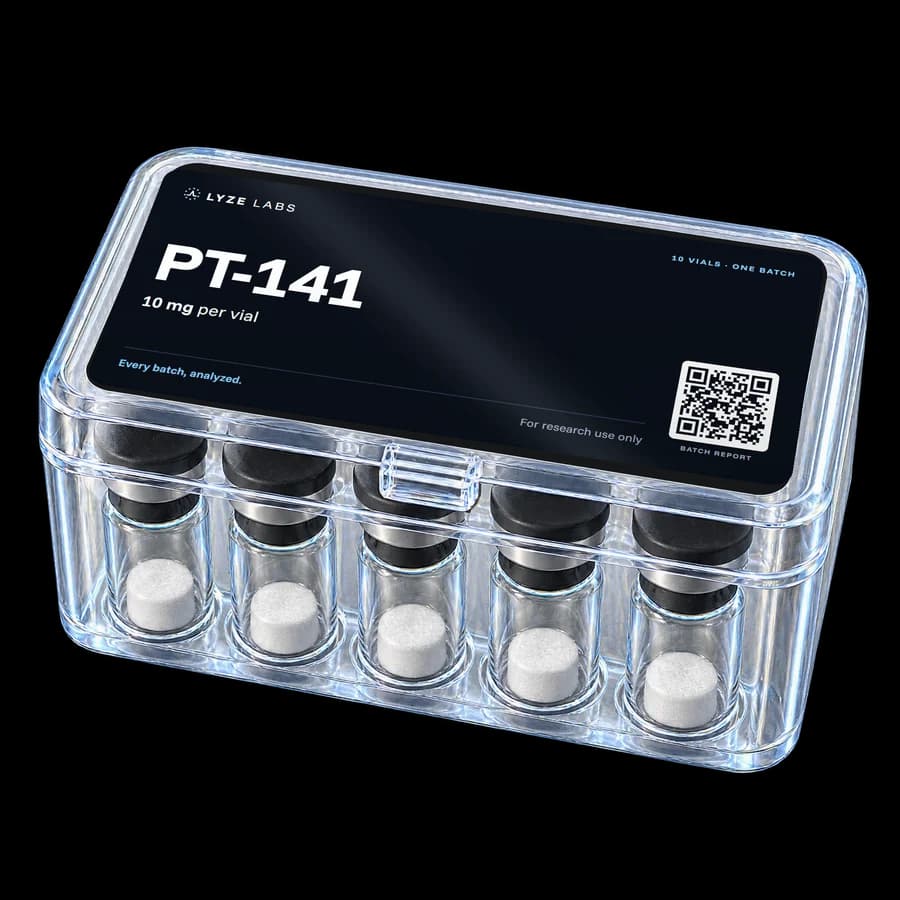
Lyze Labs supplies PT-141 (Bremelanotide) to researchers worldwide, as ten-vial kits of 10 mg from one batch. Shipping is free and tracked, in discreet packaging, and most orders arrive in 7 to 14 days. Every order is backed by third-party HPLC testing and a per-batch COA, and the company is trusted by researchers in 150+ countries, with 10,000+ orders shipped. You can pay by Visa, Mastercard, Amex, PayPal, Apple Pay, Google Pay, bank transfer, local wallets and bank apps in your region, or crypto (USDT, USDC, BTC).
Frequently Asked Questions
What is PT-141 (Bremelanotide) used for in research?
PT-141 switches on the melanocortin receptors and is used mainly as a probe of MC3R and MC4R signaling in the brain. Researchers studying arousal and motivation use it to isolate MC4R effects in cell and animal models. It is for laboratory and research use only.
How does PT-141 differ from peripheral-acting compounds?
PT-141 acts in the brain, on melanocortin receptors in the hypothalamus, raising cAMP through MC4R. PDE5 compounds act on the nitric oxide pathway in blood vessels. They are different classes of compound, which is why researchers often study them together.
What purity should laboratory-grade PT-141 have?
Research-grade PT-141 should be verified above 99 percent purity by HPLC, with mass spectrometry confirming a molecular weight near 1025.2 Da. The most reliable evidence is a batch-specific Certificate of Analysis from third-party testing. Lyze Labs provides a COA per batch on all PT-141 material.
What are the reported chemical specifications of PT-141?
PT-141 has a base CAS of 189691-06-3, a formula of C50H68N14O10 and a molecular weight near 1025.2 Da. The acetate salt has CAS 1607799-13-2. Its half-life is about 2.7 hours.
How should PT-141 be stored in a research setting?
Keep freeze-dried PT-141 frozen and away from light, where it stays stable for a long time. Once mixed with bacteriostatic water, keep it in the fridge and use it within a limited window, since dissolved peptides break down faster than dry powder.
How can I order PT-141 from Lyze Labs?
Add the kit to your cart and place your order; a person confirms it and sends payment options, day or night. Shipping is free and discreet worldwide, with typical delivery in 7 to 14 days and a COA included per batch.
Researchers ready to source verified, HPLC-tested material can order PT-141 (Bremelanotide) directly through Lyze Labs. Every order ships free worldwide with a per-batch COA and purity above 99 percent.
Studies Cited
- Kingsberg SA, et al. (2019). Bremelanotide for the treatment of hypoactive sexual desire disorder: two randomized phase 3 trials. Obstetrics and Gynecology.
- Pfaus JG, et al. (2004). Selective facilitation of sexual solicitation in the female rat by a melanocortin receptor agonist. Proceedings of the National Academy of Sciences.
This guide is for education. It is not medical advice. Every compound we supply is for laboratory research only and is not for human use.