HGH Fragment 176-191: The Lipolytic C-Terminal Peptide Research Guide
HGH Fragment 176-191 is the lipolytic C-terminal tail of human growth hormone, studied for fat metabolism in research models without the IGF-1 or glucose effects of full HGH. This guide covers mechanism, half-life, the AOD-9604 and HGH 191AA comparison, purity verification, and how to source HPLC-tested material.
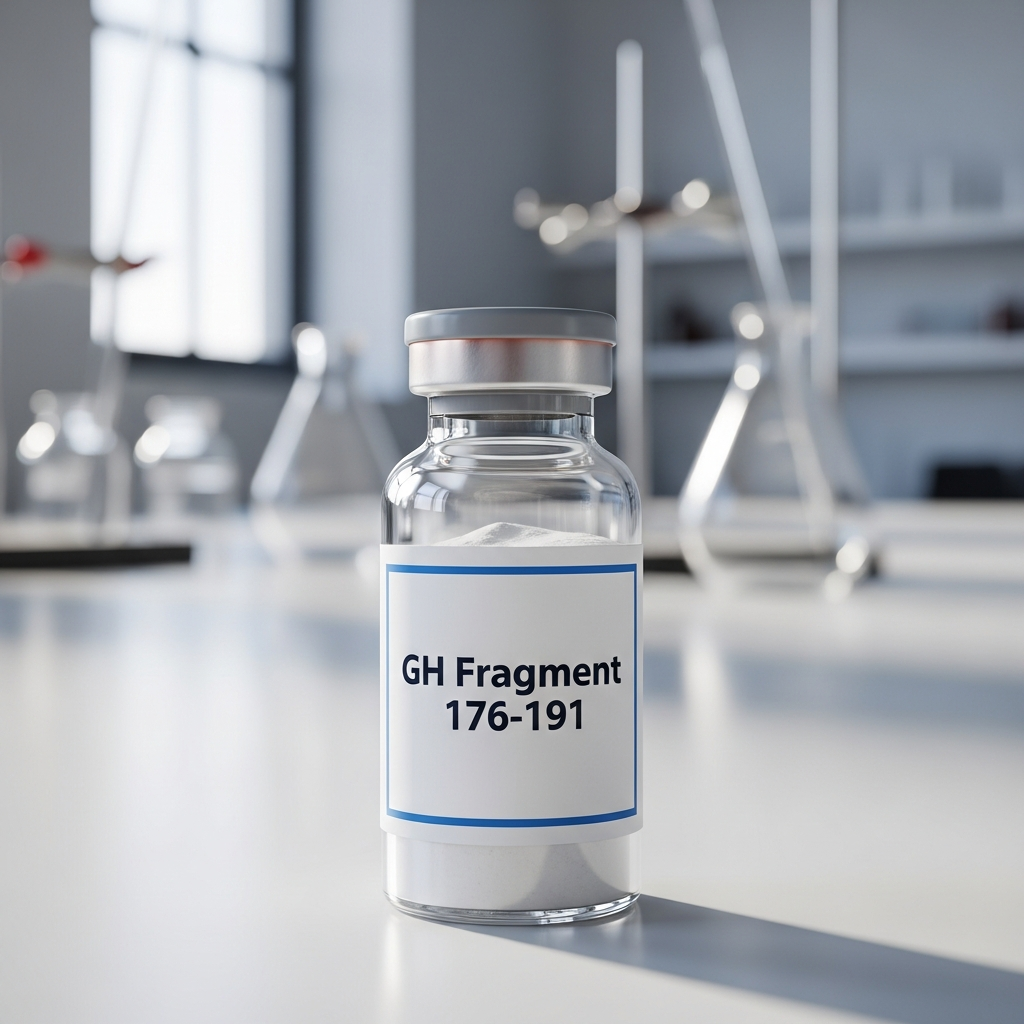
Disclaimer: This article is for educational and informational purposes only. It does not constitute medical advice. All products referenced are intended for research and laboratory use only and are not approved for human consumption.
HGH Fragment 176-191, often shortened to HGH frag or HGH 176-191, is one of the most studied fat-metabolism peptides in the research community. It represents only the final 16 amino acids of the 191-residue human growth hormone molecule, and that small stretch is exactly the part researchers care about. The C-terminal region carries the lipolytic, or fat-mobilizing, activity of growth hormone while leaving behind the segments tied to IGF-1 release and glucose disruption. That separation is why HGH Fragment 176-191 has become a recurring subject in metabolic and adipose-tissue research. This guide explains what the peptide is, how it works in research models, the molecular data that matter, and how it compares to AOD-9604 and full-length HGH 191AA. All material discussed here is for research and laboratory use only.
Key Takeaways
- HGH Fragment 176-191 is the lipolytic C-terminal fragment of human growth hormone (amino acids 176 to 191), a 16-residue linear peptide with the sequence Phe-Leu-Arg-Ile-Val-Gln-Cys-Arg-Ser-Val-Glu-Gly-Ser-Cys-Gly-Phe.
- CAS number is 66004-57-7, molecular formula C78H123N23O22S2, and free-base molecular weight near 1799 g/mol (slightly higher as the acetate salt).
- In research models it is studied for stimulating lipolysis and inhibiting lipogenesis through a beta-3 adrenergic pathway, without raising IGF-1, insulin, or blood glucose.
- AOD-9604 is a stabilized modification of this fragment with an added N-terminal tyrosine and a disulfide bridge, giving it more enzymatic resistance and a larger human research record.
- Full HGH 191AA is the complete hormone with both lipolytic and growth-signaling domains, so it behaves very differently from the isolated fragment.
- Lyze Labs supplies HGH Fragment 176-191 third-party HPLC tested at 99%+ purity with a published COA, shipped free and discreetly worldwide in 7 to 14 days.
What Is HGH Fragment 176-191?
Human growth hormone is a single chain of 191 amino acids produced by the pituitary. Decades of separation work showed that its many actions are not spread evenly across the molecule. The fat-mobilizing activity concentrates near the C-terminal tail, while the segments responsible for cell growth signaling and IGF-1 production sit elsewhere in the chain. HGH Fragment 176-191 isolates that tail, residues 176 through 191, into a short synthetic peptide.
Because the fragment lacks the binding domains required to activate the growth hormone receptor in the classical way, researchers investigating it observe the lipolytic behavior of growth hormone without the broader endocrine cascade. This is the central reason the peptide is grouped with research peptides studied for fat metabolism rather than with growth-signaling compounds like HGH 191AA somatropin. It is a targeted tool, not a hormone replacement.
A practical note for the lab: the fragment is supplied as a lyophilized (freeze-dried) white powder and is sensitive to repeated freeze-thaw cycles and heat. Proper handling matters for data integrity, which is covered in our peptide storage and stability guide.
Mechanism of Action in Research Models
The working model for HGH Fragment 176-191 in published adipocyte studies is built on beta-3 adrenergic signaling. The fragment is thought to interact with beta-3 adrenergic receptors on the surface of fat cells. That interaction raises cyclic AMP, which activates protein kinase A, which in turn switches on the two enzymes that drive fat breakdown: hormone-sensitive lipase (HSL) and adipose triglyceride lipase (ATGL).
The result observed in isolated adipocyte models is twofold. First, stored triglycerides are mobilized and broken down faster, a process called lipolysis. Second, the fragment appears to suppress lipogenesis, the formation of new fat. Some in-vitro work reports lipolysis rates rising substantially above untreated controls. Because the mechanism routes through beta-3 receptors rather than the growth hormone receptor, the downstream growth-signaling effects of full HGH are largely absent in these models.
It is worth being precise about the evidence. HGH Fragment 176-191 has a limited record of dedicated human clinical trials. A large share of what gets attributed to it in the research community is extrapolated from its better-studied cousin AOD-9604. Serious researchers treat the fragment as a promising in-vitro and animal-model lipolytic agent, not a proven human therapeutic.
The IGF-1 and Glucose Question
The most cited reason for interest in HGH Fragment 176-191 is what it does not do. Full growth hormone is diabetogenic, meaning it can raise blood glucose and is closely tied to IGF-1 output. Those effects trace largely to the N-terminal and central regions of the hormone, not the C-terminal tail.
In animal and cell studies, the isolated 176-191 fragment did not meaningfully change blood glucose, insulin, or IGF-1 levels while still showing lipolytic activity. For researchers, this is the appeal: a model for studying fat mobilization that decouples it from the glucose and growth-factor pathways that complicate full HGH experiments. This metabolic selectivity is the single property that defines the peptide's research niche and separates it from broader-acting GLP-1 class compounds.
HGH Fragment 176-191 vs AOD-9604 vs HGH 191AA
The three compounds are constantly confused because they share lineage. The table below makes the distinctions clear.
| Property | HGH Fragment 176-191 | AOD-9604 | HGH 191AA (Somatropin) |
|---|---|---|---|
| Structure | C-terminal fragment, residues 176-191, linear | Residues 177-191 plus N-terminal tyrosine, disulfide bridge | Full 191-amino-acid hormone |
| Approx. molecular weight | ~1799 g/mol (free base) | ~1815 g/mol | ~22,100 g/mol |
| CAS number | 66004-57-7 | 221231-10-3 | 12629-01-5 |
| Primary research focus | Lipolysis, fat metabolism | Lipolysis, cartilage research | Growth signaling, IGF-1, recovery |
| Enzymatic stability | Lower (linear, plasma-degradable) | Higher (disulfide bridge resists breakdown) | Stable globular protein |
| IGF-1 / glucose effect in models | Minimal | Minimal | Significant |
| Human research record | Limited | More extensive, incl. clinical trials | Extensive |
The key takeaway is structural. AOD-9604 was engineered from the same C-terminal region but stabilized with an added tyrosine and a disulfide bridge between cysteine residues, making it more resistant to enzymatic degradation in plasma. That gives AOD-9604 a longer effective window and a deeper human research history, even though its trials did not deliver results sufficient for pharmaceutical approval. HGH 191AA, by contrast, is the entire hormone and carries the full set of growth-signaling and glucose effects the fragment was designed to avoid. Choosing between them depends entirely on the research question.
Molecular Profile and Reconstitution
For accurate lab work, the identity data should match the COA exactly.
| Specification | Value |
|---|---|
| Sequence | Phe-Leu-Arg-Ile-Val-Gln-Cys-Arg-Ser-Val-Glu-Gly-Ser-Cys-Gly-Phe |
| Amino acids | 16 |
| CAS number | 66004-57-7 |
| Molecular formula | C78H123N23O22S2 |
| Molecular weight | ~1799 g/mol (free base) |
| Appearance | Lyophilized white powder |
| Form | Acetate salt |
The peptide is reconstituted with bacteriostatic water for research handling and kept cold once in solution, since the linear structure makes it vulnerable to degradation over time. Step-by-step preparation practice is documented in our guide to reconstituting research peptides. Because the fragment has a relatively short plasma half-life in models, careful handling and accurate measurement directly affect the reliability of results.
Sourcing and Purity Verification
A fat-metabolism peptide is only as good as the molecule in the vial. Mislabeled or impure material is the fastest way to ruin a dataset, and the unregulated end of this market is full of it. That is why every batch of HGH Fragment 176-191 from Lyze Labs is third-party HPLC tested and shipped with a published certificate of analysis confirming 99%+ purity. Identity and purity should always be verified before any research begins, a process detailed in our COA and purity verification guide.
Lyze Labs is trusted by more than 12,000 researchers across 50 or more countries and holds a 4.8 out of 5 rating from verified reviews. Demand for lipolytic and GLP-1 class peptides has surged, and batches are produced in limited runs, so current batch pricing reflects present availability rather than a guarantee for future lots. Researchers who want to lock in verified material at the current rate are advised to secure their order while the active batch is in stock.
Ordering is straightforward. WhatsApp is the fastest channel and gives you direct order confirmation, and Lyze Labs also accepts Visa and Mastercard, UPI, PayPal, CashApp, bank and wire transfer, and crypto including BTC, USDT, and ETH. Shipping is free, discreet, and worldwide, typically arriving in 7 to 14 days. New to importing research compounds? Read our international peptide shipping and customs guide first.
Frequently Asked Questions
What is HGH Fragment 176-191 used for in research?
HGH Fragment 176-191 is studied in laboratory and animal models for its effects on fat metabolism, specifically stimulating lipolysis (fat breakdown) and inhibiting lipogenesis (fat formation). Researchers investigating metabolic pathways value it because it appears to isolate the lipolytic action of growth hormone. It is supplied strictly for research and laboratory use only and is not for human consumption.
How is HGH frag 176-191 different from full HGH 191AA?
HGH 191AA is the complete 191-amino-acid growth hormone with a molecular weight near 22,100 g/mol, carrying both growth-signaling and fat-metabolism domains. HGH Fragment 176-191 is only the final 16 amino acids, weighing about 1799 g/mol, and in research models it shows lipolytic activity without meaningfully raising IGF-1, insulin, or glucose. The fragment is a targeted research tool, while full HGH affects the whole growth-hormone axis.
Does HGH 176-191 affect IGF-1 or blood glucose?
In published animal and cell studies, the isolated HGH 176-191 fragment did not meaningfully alter IGF-1, insulin, or blood glucose levels, which is its defining research characteristic. Those effects in full growth hormone come from regions outside the C-terminal tail. This metabolic selectivity is the main reason researchers separate the fragment from full HGH in study designs.
Is HGH Fragment 176-191 better than AOD-9604?
Neither is universally better; they suit different research questions. AOD-9604 is a stabilized version of the same C-terminal region with an added tyrosine and a disulfide bridge, giving it greater enzymatic resistance and a larger human research record. HGH Fragment 176-191 is the original linear fragment with a shorter plasma half-life. Researchers comparing them weigh stability and evidence base against simplicity and cost.
What is the CAS number and molecular weight of HGH Fragment 176-191?
The CAS number is 66004-57-7, the molecular formula is C78H123N23O22S2, and the free-base molecular weight is approximately 1799 g/mol, with the acetate salt form running slightly higher. These values should match the certificate of analysis supplied with any research-grade batch. Always confirm identity data against the COA before beginning work.
How can I verify HGH frag 176-191 purity before ordering?
Reputable suppliers provide a third-party HPLC certificate of analysis showing purity, identity, and batch number. Lyze Labs publishes a COA confirming 99%+ purity for every HGH Fragment 176-191 batch and supports batch verification on request. Reviewing the COA and checking for HPLC and mass spectrometry data is the single most reliable step, as outlined in our peptide purity verification guide.
Order Research-Grade HGH Fragment 176-191
For researchers who need verified, HPLC-tested material with a published COA at 99%+ purity, HGH Fragment 176-191 is in stock now with free discreet worldwide shipping in 7 to 14 days. Current batch pricing applies only while the active lot lasts. Message Lyze Labs on WhatsApp for the fastest confirmation, or place your order through the product page and pay by card, UPI, PayPal, CashApp, bank transfer, or crypto. Secure the current batch before it sells through.
Related Research Guides
AOD-9604 Research Guide: The HGH Fragment 176-191 Fat-Loss Peptide Explained
A research-grade guide to AOD-9604, the modified HGH fragment 176-191 peptide studied for lipolysis without growth hormone effects. Mechanism, study findings, structure, and how it compares to Fragment 176-191, with sourcing and purity guidance for laboratory researchers.
Tesamorelin Research Guide: GHRH Analog, Visceral Fat, and IGF-1
Tesamorelin is a stabilized GHRH analog studied for its effect on growth hormone release and visceral adipose tissue. This guide covers its mechanism, the visceral fat and IGF-1 research, how it compares to Sermorelin and CJC-1295, and what defines laboratory-grade quality.
SLU-PP-332: The Exercise-Mimetic ERR Agonist Research Guide
SLU-PP-332 is a synthetic ERR agonist studied as an exercise mimetic for metabolic and endurance research. This guide covers its mechanism, key preclinical findings, and how researchers source 99%+ purity material with a published COA.