SLU-PP-332: The Exercise-Mimetic ERR Agonist Research Guide
SLU-PP-332 is a synthetic ERR agonist studied as an exercise mimetic for metabolic and endurance research. This guide covers its mechanism, key preclinical findings, and how researchers source 99%+ purity material with a published COA.
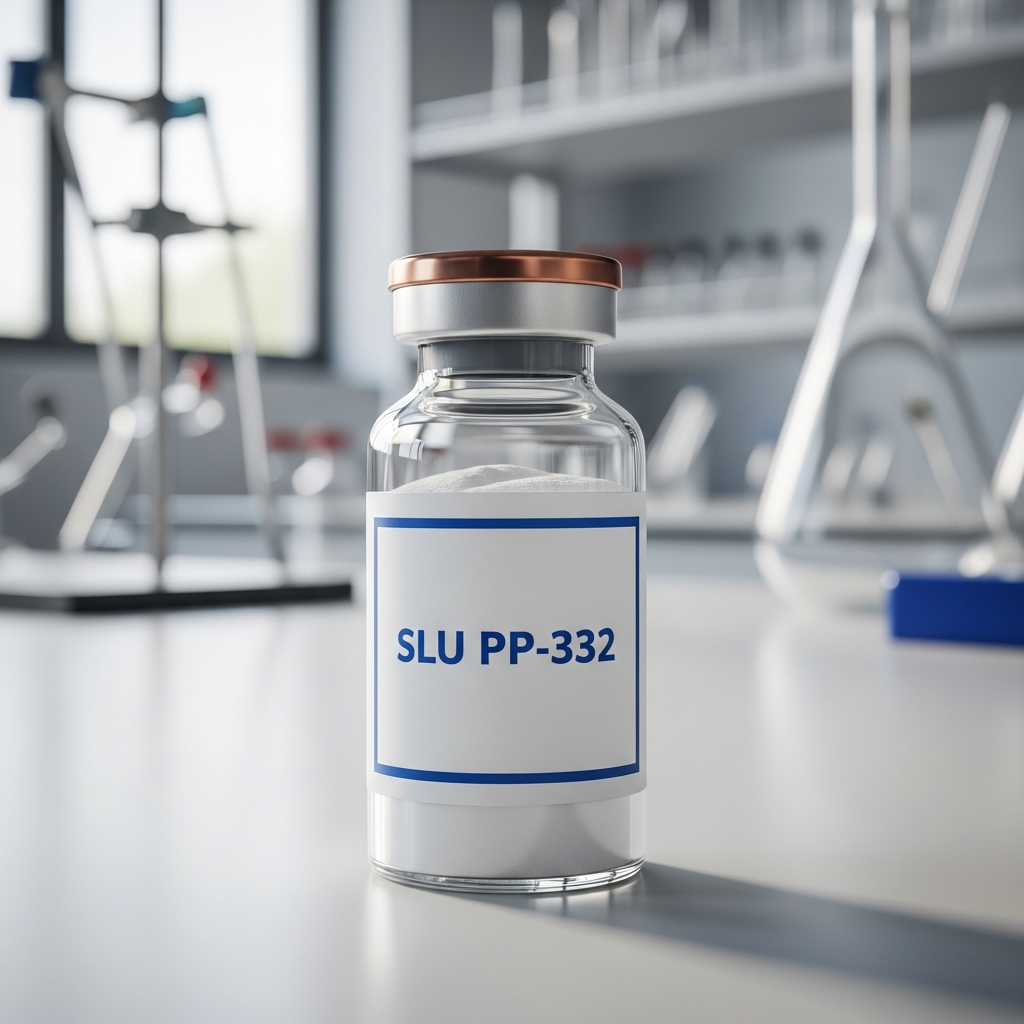
Disclaimer: This article is for educational and informational purposes only. It does not constitute medical advice. All products referenced are intended for research and laboratory use only and are not approved for human consumption.
SLU-PP-332 is one of the fastest-rising names in metabolic research, and for good reason. Search interest around "slu pp 332" has surged as laboratories investigate a single, provocative idea: a synthetic compound that switches on the same genetic program muscle activates during endurance exercise, without the treadmill. It is frequently grouped with research peptides because it shares the same metabolic research space as GLP-1 agonists, but SLU-PP-332 is not a true peptide. It is a small-molecule estrogen-related receptor (ERR) agonist, and understanding that distinction is the first step to using it correctly in a research setting. This guide answers what SLU-PP-332 is, how its mechanism works, what the published studies actually show, and how researchers source verified, high-purity material.
All information below is provided strictly for laboratory and research use only. Nothing here is a dosing protocol, medical guidance, or a suggestion for human use.
Key Takeaways
- SLU-PP-332 is a synthetic small-molecule pan-ERR agonist (with slight selectivity for ERRalpha), first synthesized at Saint Louis University, studied as an "exercise mimetic."
- It is not a true peptide. It is sold as a research compound and shares lab space with metabolic peptides like retatrutide and tirzepatide.
- Its core mechanism is activation of estrogen-related receptors, which upregulate mitochondrial biogenesis, oxidative phosphorylation, and fatty-acid oxidation gene programs.
- In published rodent research, SLU-PP-332 increased endurance capacity and reduced fat-mass accumulation while preserving lean mass.
- There is no published human pharmacokinetic or safety data. All findings are preclinical.
- Lyze Labs supplies SLU-PP-332 at 99%+ purity, third-party HPLC tested with a published COA, with free discreet worldwide shipping in 7 to 14 days.
What Is SLU-PP-332?
SLU-PP-332 is a synthetic agonist of the estrogen-related receptors, a family of three nuclear receptors known as ERRalpha, ERRbeta, and ERRgamma. It was developed by researchers at Saint Louis University as a chemical probe to study ERR signaling, and it quickly drew attention as a potential "exercise mimetic," meaning a compound that reproduces some of the molecular signatures of physical exercise at the gene-expression level.
A common point of confusion is the word "peptide." SLU-PP-332 is a small organic molecule, not a chain of amino acids. It is reasonably lipophilic, with a reported cLogP near 4.05 and very low aqueous solubility (kinetic solubility around 0.2 micromolar in characterization assays), which is why reconstitution and solvent choice matter so much in the lab. Researchers should treat it as a small-molecule research chemical, not as a conventional injectable peptide.
For broader context on how peptide and small-molecule metabolic compounds are categorized and verified, the research peptide glossary is a useful companion reference.
How the ERR Agonist Mechanism Works
Estrogen-related receptors are master regulators of cellular energy metabolism. Despite the name, they do not bind estrogen. Instead, they act as constitutive transcription factors that control the genes governing mitochondrial function. When SLU-PP-332 binds and activates these receptors, particularly ERRalpha, it drives a cascade that, in research models, looks remarkably like the body's acute response to aerobic exercise.
The most studied step is the induction of DDIT4, a protein that is rapidly upregulated after short bouts of aerobic exercise. By specifically activating ERRalpha, SLU-PP-332 triggers an acute aerobic exercise genetic program. Transcriptomic analysis of treated muscle in published studies revealed gene-expression patterns matching the acute exercise response, including the upregulation of oxidative phosphorylation components and the machinery for fatty-acid oxidation.
In plain terms, the compound nudges cells toward burning fat for fuel and building more mitochondrial capacity, the same adaptations endurance training produces over time. This is why it is described as an exercise mimetic rather than a stimulant or an appetite suppressant.
What the Research Shows: Key Preclinical Findings
The preclinical record for SLU-PP-332 is what generated the buzz. The most cited findings come from rodent studies, and they are striking when read carefully and in context.
| Research finding | Observed result (rodent models) |
|---|---|
| Endurance capacity | Treated mice ran approximately 70% longer and 45% farther before exhaustion vs. controls |
| Body weight (obese mice, 28 days) | Approximately 12% reduction in body weight |
| Fat-mass accumulation | Reduced by over 90% vs. controls |
| Lean mass | Preserved, no significant lean-mass loss observed |
| Metabolic markers | Reductions in plasma cholesterol, triglycerides, fasting glucose, and insulin |
| Fuel switching | Respiratory exchange ratio dropped within ~2 hours, indicating a rapid shift to fat oxidation |
Several points deserve emphasis. First, every one of these results comes from animal models. No Phase 1 human trial has been conducted, and no human pharmacokinetic study has been published as of this writing. Second, the rapid drop in respiratory exchange ratio is one of the most interesting signals: it suggests the compound triggers fat oxidation acutely, mimicking the metabolic state of fasting or exercise. For researchers comparing mechanisms, this is mechanistically distinct from how incretin-based compounds work, which makes side-by-side study design especially interesting.
SLU-PP-332 vs. GLP-1 Research Compounds
Researchers frequently want to position SLU-PP-332 against the GLP-1 and dual or triple agonist compounds that dominate metabolic research. The mechanisms are fundamentally different, which is precisely why they are studied together rather than as substitutes.
| Attribute | SLU-PP-332 | GLP-1 / incretin agonists (e.g. retatrutide, tirzepatide) |
|---|---|---|
| Molecule type | Small-molecule ERR agonist | Peptide hormone analogs |
| Primary mechanism | Increases energy expenditure, mitochondrial and fat-oxidation gene programs | Reduce appetite and food intake, slow gastric emptying |
| Research framing | "Exercise mimetic" (expenditure side) | Intake-reduction side |
| Lean mass in models | Preserved in rodent studies | Lean-mass changes are an active research question |
| Human clinical data | None published | Extensive clinical pipelines |
The takeaway for study design is complementarity. Incretin compounds act on the intake side of the energy equation while SLU-PP-332 acts on the expenditure and oxidative-capacity side. Researchers exploring these pathways often reference the retatrutide triple agonist research guide and the tirzepatide dual agonist research guide to frame the contrast.
Handling, Reconstitution, and Stability Considerations
Because SLU-PP-332 is a lipophilic small molecule with very low aqueous solubility, it does not behave like a typical water-soluble research peptide. In laboratory characterization, it required appropriate solvents to achieve workable concentrations, and bacteriostatic water alone is generally unsuitable for a compound with this solubility profile. Researchers should consult the certificate of analysis and material data for solvent compatibility before preparing any working solution.
General good practice for research-compound handling applies: store the lyophilized or raw material cold and protected from light, minimize freeze-thaw cycles on reconstituted stock, and label all preparations with concentration and date. Our broader peptide storage and stability guide and the reconstitution walkthrough cover the principles that keep research material intact, though always defer to compound-specific solubility data for a small molecule like this one.
Purity, Verification, and Why It Matters
With a breakout compound, demand outpaces quality control across the supplier landscape. That is the single biggest risk to reproducible research. A mislabeled or underpurity sample will quietly corrupt every downstream result. This is why batch verification is not optional.
Every batch of SLU-PP-332 from Lyze Labs is third-party HPLC tested and ships with a published certificate of analysis confirming 99%+ purity. Researchers can verify the batch identity against the COA before committing material to a study. If you are new to reading these documents, the guide to verifying research peptide purity and COA explains exactly what to look for, and the research peptide scam red flags breakdown shows the warning signs of suppliers who cut corners. With surging demand for metabolic and GLP-1 research compounds, batch availability moves quickly, so verifying current-batch COA before ordering is the practical move.
How to Order SLU-PP-332 From Lyze Labs
Lyze Labs is trusted by more than 12,000 researchers across 150+ countries, with a 4.8 out of 5 rating, and supplies SLU-PP-332 with the verification a serious laboratory needs.
- Purity: 99%+, third-party HPLC tested, published COA per batch.
- Shipping: free discreet worldwide delivery, typically 7 to 14 days.
- Payment: WhatsApp is the fastest order channel, and we also accept Visa, Mastercard, UPI, PayPal, CashApp, bank or wire transfer, and crypto including BTC, USDT, and ETH.
Because metabolic research compounds are in unusually high demand right now, current-batch pricing and stock can shift between restocks. Securing your order against the verified current batch is the surest way to lock in both pricing and a confirmed COA. Visit the SLU-PP-332 product page to review the current batch and reserve material.
Frequently Asked Questions
What is SLU-PP-332 and is it a peptide?
SLU-PP-332 is a synthetic small-molecule agonist of the estrogen-related receptors (ERRalpha, ERRbeta, ERRgamma), studied as an exercise mimetic. It is not a true peptide, meaning it is not a chain of amino acids, but it is sold and researched as a metabolic research compound alongside peptides like retatrutide. It is for laboratory and research use only.
How does the SLU-PP-332 peptide mechanism work?
SLU-PP-332 activates estrogen-related receptors, with slight preference for ERRalpha, which switch on genes controlling mitochondrial biogenesis, oxidative phosphorylation, and fatty-acid oxidation. In research models this reproduces the molecular signature of acute aerobic exercise, including induction of DDIT4, which is why it is called an exercise mimetic.
What did SLU-PP-332 research findings show?
In rodent studies, SLU-PP-332 increased endurance (mice ran roughly 70% longer), reduced body weight by about 12% over 28 days in obese models, cut fat-mass accumulation by over 90%, and preserved lean mass. It also shifted metabolism toward fat oxidation within about two hours of dosing. All findings are preclinical, with no published human data.
Is SLU-PP-332 safe for humans?
There is no published human safety or pharmacokinetic data for SLU-PP-332. No Phase 1 trial has been completed, so it must be treated strictly as a research compound for laboratory use only. It is not approved for human consumption and should never be used outside a controlled research context.
How is SLU-PP-332 different from retatrutide or tirzepatide?
SLU-PP-332 is a small-molecule ERR agonist that increases energy expenditure and oxidative capacity, while retatrutide and tirzepatide are peptide incretin agonists that primarily reduce appetite and food intake. They act on opposite sides of the energy balance equation, which is why researchers study them as complementary rather than interchangeable.
Where can I buy SLU-PP-332 with a verified COA?
Lyze Labs supplies SLU-PP-332 at 99%+ purity, third-party HPLC tested with a published certificate of analysis for every batch. Order via WhatsApp for the fastest processing, or pay by card, UPI, PayPal, CashApp, bank transfer, or crypto, with free discreet worldwide shipping in 7 to 14 days.
Ready to Secure Your Batch?
SLU-PP-332 is moving fast as metabolic research demand surges, and verified, COA-backed material is the difference between reproducible data and wasted work. Review the current verified batch on the SLU-PP-332 product page and message us on WhatsApp to lock in current-batch pricing today. For research use only.
Related Research Guides
HGH Fragment 176-191: The Lipolytic C-Terminal Peptide Research Guide
HGH Fragment 176-191 is the lipolytic C-terminal tail of human growth hormone, studied for fat metabolism in research models without the IGF-1 or glucose effects of full HGH. This guide covers mechanism, half-life, the AOD-9604 and HGH 191AA comparison, purity verification, and how to source HPLC-tested material.
AOD-9604 Research Guide: The HGH Fragment 176-191 Fat-Loss Peptide Explained
A research-grade guide to AOD-9604, the modified HGH fragment 176-191 peptide studied for lipolysis without growth hormone effects. Mechanism, study findings, structure, and how it compares to Fragment 176-191, with sourcing and purity guidance for laboratory researchers.
Tesamorelin Research Guide: GHRH Analog, Visceral Fat, and IGF-1
Tesamorelin is a stabilized GHRH analog studied for its effect on growth hormone release and visceral adipose tissue. This guide covers its mechanism, the visceral fat and IGF-1 research, how it compares to Sermorelin and CJC-1295, and what defines laboratory-grade quality.