Tesamorelin Research Guide: GHRH Analog, Visceral Fat, and IGF-1
Tesamorelin is a stabilized GHRH analog studied for its effect on growth hormone release and visceral adipose tissue. This guide covers its mechanism, the visceral fat and IGF-1 research, how it compares to Sermorelin and CJC-1295, and what defines laboratory-grade quality.
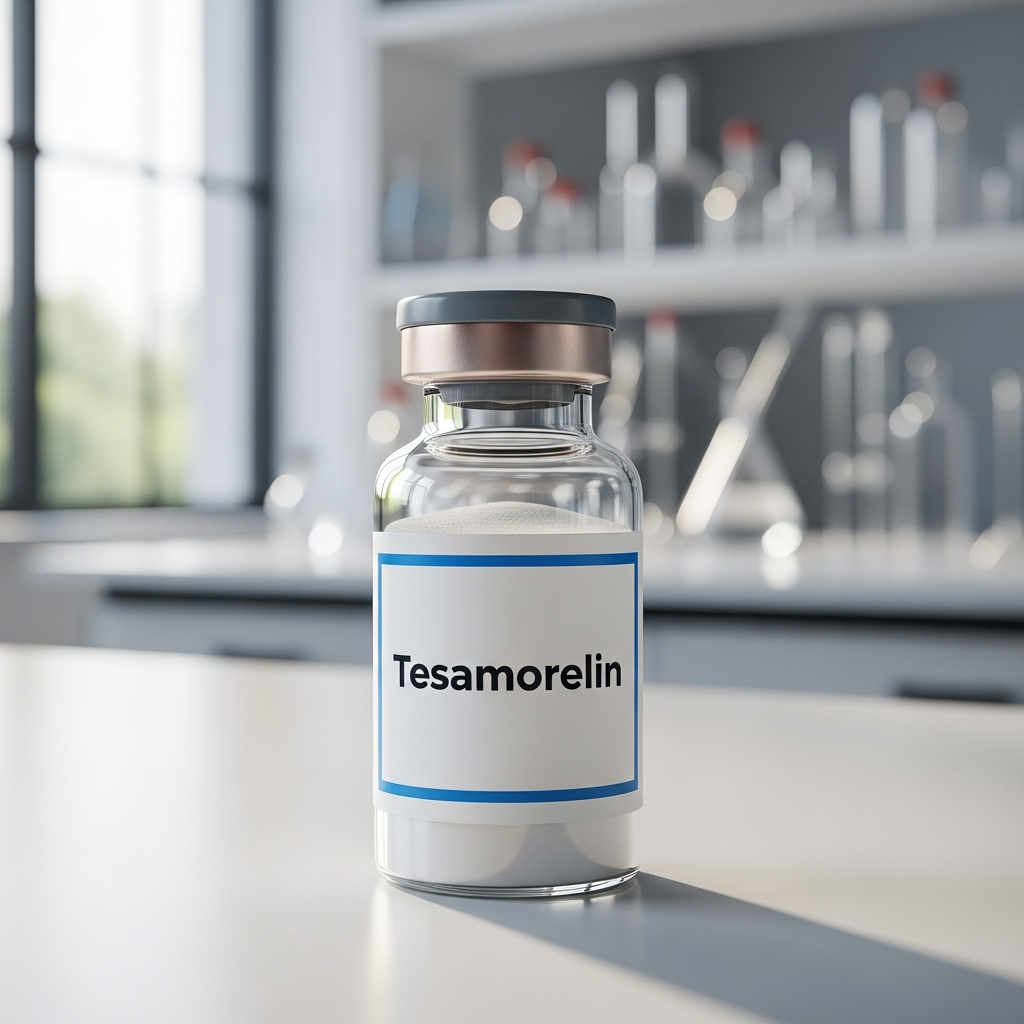
Disclaimer: This article is for educational and informational purposes only. It does not constitute medical advice. All products referenced are intended for research and laboratory use only and are not approved for human consumption.
Among growth hormone-releasing peptides, Tesamorelin occupies a distinct position: it is a stabilized analog of human growth hormone-releasing hormone (GHRH) and the most rigorously studied member of its class, with the strongest published data on visceral adipose tissue. For researchers investigating the GH/IGF-1 axis and fat distribution in laboratory models, Tesamorelin offers a well-characterized mechanism, a clean pharmacokinetic profile, and a body of controlled-trial literature that few research peptides can match. This guide walks through what the compound is, why it draws sustained scientific interest, and how it compares to the other GHRH-class peptides researchers evaluate.
Key Takeaways
- Tesamorelin is a synthetic 44-amino-acid GHRH analog (CAS 218949-48-5, molecular weight approximately 5135.9 Da) modified with a trans-3-hexenoic acid group that resists enzymatic degradation.
- It binds the GHRH receptor on anterior pituitary somatotroph cells and stimulates pulsatile growth hormone release, with downstream elevation of IGF-1.
- Published controlled trials report reductions in visceral adipose tissue of roughly 15 to 18 percent over 26 weeks in studied populations, alongside meaningful liver fat reductions.
- Its plasma half-life is short, roughly 26 to 38 minutes, which supports pulsatile signaling without sustained receptor desensitization.
- Compared to Sermorelin (shorter, weaker) and CJC-1295 with DAC (much longer-acting), Tesamorelin sits in a well-validated middle position with the deepest visceral-fat evidence base.
- Laboratory-grade material should arrive lyophilized with a batch-specific COA confirming purity above 99 percent by HPLC.
What Tesamorelin Is and How It Works
Tesamorelin is a synthetically produced analog of the full 44-amino-acid sequence of human GHRH. Native GHRH is rapidly broken down in plasma, largely by the enzyme dipeptidyl peptidase-4 (DPP-IV), which limits its usefulness as a research tool. Tesamorelin addresses this with an N-terminal trans-3-hexenoic acid modification that shields the molecule from enzymatic cleavage and extends its functional stability relative to unmodified GHRH.
Mechanistically, the peptide binds the GHRH receptor on somatotroph cells in the anterior pituitary. Receptor engagement activates the cAMP/PKA signaling pathway, which prompts the release of endogenous growth hormone. Because Tesamorelin works upstream at the pituitary rather than introducing exogenous GH directly, the resulting GH release in research models follows a more physiologically pulsatile pattern. That pulsatility then drives a downstream rise in insulin-like growth factor 1 (IGF-1), the principal mediator of many GH-associated effects.
This upstream, pulsatile mechanism is the central reason GHRH analogs interest researchers studying the GH/IGF-1 axis. Rather than overriding the body's feedback loops, the compound amplifies a natural signaling cascade, which makes it a useful probe for investigating how endogenous GH secretion influences metabolism, body composition, and tissue signaling in controlled settings.
Why Researchers Are Interested: Visceral Fat and IGF-1
The defining feature of Tesamorelin in the scientific literature is its effect on visceral adipose tissue (VAT), the metabolically active fat surrounding internal organs. A landmark randomized controlled trial reported in the New England Journal of Medicine documented a mean visceral fat reduction of roughly 18 percent over 26 weeks compared to placebo in a studied population with abdominal fat accumulation. Critically, the effect was selective: trunk and visceral fat declined while extremity (subcutaneous) fat was largely preserved, and lipid profiles improved.
More recent investigations have extended these findings. In studies running 12 months, researchers observed continued VAT reduction alongside a notable relative reduction in liver fat fraction, with one dataset reporting an approximately 31 percent relative decrease in hepatic fat versus essentially no change in the placebo arm. This liver-fat signal has made Tesamorelin a compound of growing interest in non-alcoholic fatty liver research models.
The IGF-1 response is the biochemical fingerprint of activity. Published work shows Tesamorelin administration raising IGF-1 by roughly 50 to 100 ng/mL from baseline, confirming downstream GH-axis engagement. Beyond body composition, exploratory research has examined favorable effects on measures of cognition, including executive function and verbal memory, in studied older populations, broadening the scientific questions the compound is used to probe.
Search interest reflects this momentum. Reported query volume for Tesamorelin in the United States grew sharply across late 2025 into early 2026, mirroring broader surging demand across the GLP-1 and metabolic peptide categories.
How Tesamorelin Compares to Sermorelin and CJC-1295
All three of these compounds act on the same GHRH receptor, but each takes a structurally different approach to extending the short functional window of native GHRH. The practical differences matter when designing a research protocol.
| Compound | Class | Functional half-life | Visceral-fat evidence | Typical research use |
|---|---|---|---|---|
| Tesamorelin | Stabilized 44-aa GHRH analog | ~26 to 38 min | Strongest, controlled-trial data | VAT, liver fat, IGF-1 axis studies |
| Sermorelin | 29-aa GHRH fragment | Very short (~10 to 20 min) | Limited | Short, precisely timed GH-pulse studies |
| CJC-1295 (with DAC) | GHRH analog + albumin binder | Very long (~6 to 8 days) | Limited | Sustained-elevation, low-frequency dosing models |
Sermorelin is the shortest and least potent of the group, a truncated GHRH fragment useful for tightly timed, acute pulse experiments. CJC-1295 with DAC sits at the opposite extreme: an albumin-binding Drug Affinity Complex stretches its half-life to roughly a week, producing sustained GH elevation that reduces dosing frequency but blunts natural pulsatility. Researchers comparing the dual-action stack often pair it with a ghrelin mimetic, a pattern covered in our CJC-1295 and Ipamorelin stack research guide.
Tesamorelin occupies the validated middle. Its half-life is longer than Sermorelin yet far shorter than CJC-1295 with DAC, preserving pulsatile signaling while delivering the most robust, controlled-trial evidence base of the three, particularly on visceral fat. For researchers whose primary endpoint is VAT or hepatic fat, Tesamorelin is generally the reference compound, which is a major reason it remains a cornerstone of the Lyze Labs Tesamorelin catalog.
What to Look For in Research-Grade Quality
A 44-amino-acid peptide with a custom lipid modification is synthetically demanding to produce correctly, which makes verification non-negotiable. Impure or incompletely synthesized batches can carry truncated sequences, deletion peptides, or residual solvents that confound data and make experiments unreproducible.
The single most important document is a batch-specific Certificate of Analysis (COA). A credible COA reports purity by high-performance liquid chromatography (HPLC), typically with mass spectrometry confirming molecular identity against the expected ~5135.9 Da mass. Lyze Labs material is pharmaceutical-grade, third-party HPLC tested, and ships with a COA available per batch confirming purity above 99 percent. For a full walkthrough of reading and validating these documents, see our guide on how to verify research peptide purity and read a COA.
Verification also protects against fraud. The peptide market carries persistent counterfeiting and underdosing risks, and learning the warning signs is part of responsible sourcing. Our overview of research peptide scam red flags details the patterns that separate legitimate suppliers from resellers of unverified material. With Tesamorelin, a missing COA, a vague purity claim, or a refusal to disclose batch testing should end the evaluation.
Reconstitution and Storage Notes for Research Settings
Tesamorelin is supplied as a lyophilized (freeze-dried) white powder, the standard format for peptide stability during transit and storage. In laboratory settings, reconstitution is performed with an appropriate sterile diluent, most commonly bacteriostatic or sterile water, added gently down the side of the vial. Researchers typically swirl or roll the vial slowly rather than shaking, since vigorous agitation can shear and denature the peptide chain.
For stability, the lyophilized powder tolerates ambient temperature briefly during shipping, but long-term storage of unreconstituted vials should be at minus 20 degrees Celsius, protected from light. Once reconstituted, the solution should be refrigerated and used within a limited window, as peptides in solution degrade faster than in their dry state. General handling principles apply across the GHRH class, and our peptide storage and stability guide covers freeze-thaw cycles, light exposure, and shelf-life expectations in detail. These notes are framed strictly for laboratory handling and are not human-use instructions.
Sourcing Tesamorelin
Securing consistent, verified material is the practical bottleneck for any serious research program. Lyze Labs ships Tesamorelin worldwide with free, discreet packaging and typical delivery in 7 to 14 days, and is trusted by more than 12,000 researchers across 50-plus countries. Every batch is third-party HPLC tested with a COA confirming purity above 99 percent.
Given surging global demand across the peptide category, batch availability is limited and current batch pricing is not guaranteed to hold. Researchers planning multi-month studies are advised to secure their supply early to avoid mid-protocol stock gaps. Ordering is fastest via WhatsApp, and Lyze Labs also accepts Visa, Mastercard, UPI, PayPal, CashApp, bank or wire transfer, and crypto including BTC, USDT, and ETH.
Frequently Asked Questions
What is Tesamorelin used for in research?
Tesamorelin is studied primarily as a tool for investigating growth hormone release, visceral adipose tissue regulation, liver fat, and the IGF-1 axis in laboratory models. It is the most validated GHRH analog for visceral fat endpoints in the published literature. All Lyze Labs material is supplied strictly for research and laboratory use only.
How does Tesamorelin differ from Sermorelin?
Both are GHRH analogs acting on the same pituitary receptor, but Sermorelin is a shorter 29-amino-acid fragment with a very brief half-life, while Tesamorelin is the full stabilized 44-amino-acid sequence with greater resistance to enzymatic breakdown. Tesamorelin also carries a far deeper controlled-trial evidence base, especially on visceral fat reduction in studied populations.
What is the half-life of Tesamorelin?
Research data indicate a plasma half-life of roughly 26 to 38 minutes. This relatively short window supports pulsatile growth hormone signaling in research models without driving the sustained receptor desensitization associated with much longer-acting analogs like CJC-1295 with DAC.
How should Tesamorelin be stored?
Lyophilized Tesamorelin should be kept at minus 20 degrees Celsius for long-term storage, protected from light, and can tolerate ambient temperature only briefly during transit. Once reconstituted in laboratory settings, the solution should be refrigerated and used within a short window because dissolved peptides degrade faster than the dry powder.
How can I confirm Tesamorelin purity?
Request the batch-specific Certificate of Analysis, which should report HPLC purity, ideally above 99 percent, and mass spectrometry confirming the expected molecular weight near 5135.9 Da. Lyze Labs provides a COA per batch from third-party testing. Our purity and COA verification guide explains how to read each section.
Does Lyze Labs ship Tesamorelin internationally?
Yes. Lyze Labs offers free worldwide shipping with discreet packaging and typical delivery in 7 to 14 days, serving researchers across more than 50 countries. Multiple payment methods are accepted, with WhatsApp as the fastest ordering channel.
Ready to source verified, HPLC-tested material for your study? Secure current batch pricing on the Lyze Labs Tesamorelin product page or message the team directly on WhatsApp for the fastest response and worldwide discreet shipping.
Related Research Guides
HGH Fragment 176-191: The Lipolytic C-Terminal Peptide Research Guide
HGH Fragment 176-191 is the lipolytic C-terminal tail of human growth hormone, studied for fat metabolism in research models without the IGF-1 or glucose effects of full HGH. This guide covers mechanism, half-life, the AOD-9604 and HGH 191AA comparison, purity verification, and how to source HPLC-tested material.
AOD-9604 Research Guide: The HGH Fragment 176-191 Fat-Loss Peptide Explained
A research-grade guide to AOD-9604, the modified HGH fragment 176-191 peptide studied for lipolysis without growth hormone effects. Mechanism, study findings, structure, and how it compares to Fragment 176-191, with sourcing and purity guidance for laboratory researchers.
SLU-PP-332: The Exercise-Mimetic ERR Agonist Research Guide
SLU-PP-332 is a synthetic ERR agonist studied as an exercise mimetic for metabolic and endurance research. This guide covers its mechanism, key preclinical findings, and how researchers source 99%+ purity material with a published COA.