Kisspeptin-10: A Research Guide to the HPG Axis Regulator and GnRH Release
Kisspeptin-10 is the decapeptide fragment that sits upstream of GnRH and gates the entire hypothalamic-pituitary-gonadal axis. This research guide covers its GPR54 mechanism, half-life, KP-10 versus KP-54 potency, and the 2025 to 2026 reproductive and neuroendocrine findings driving demand.
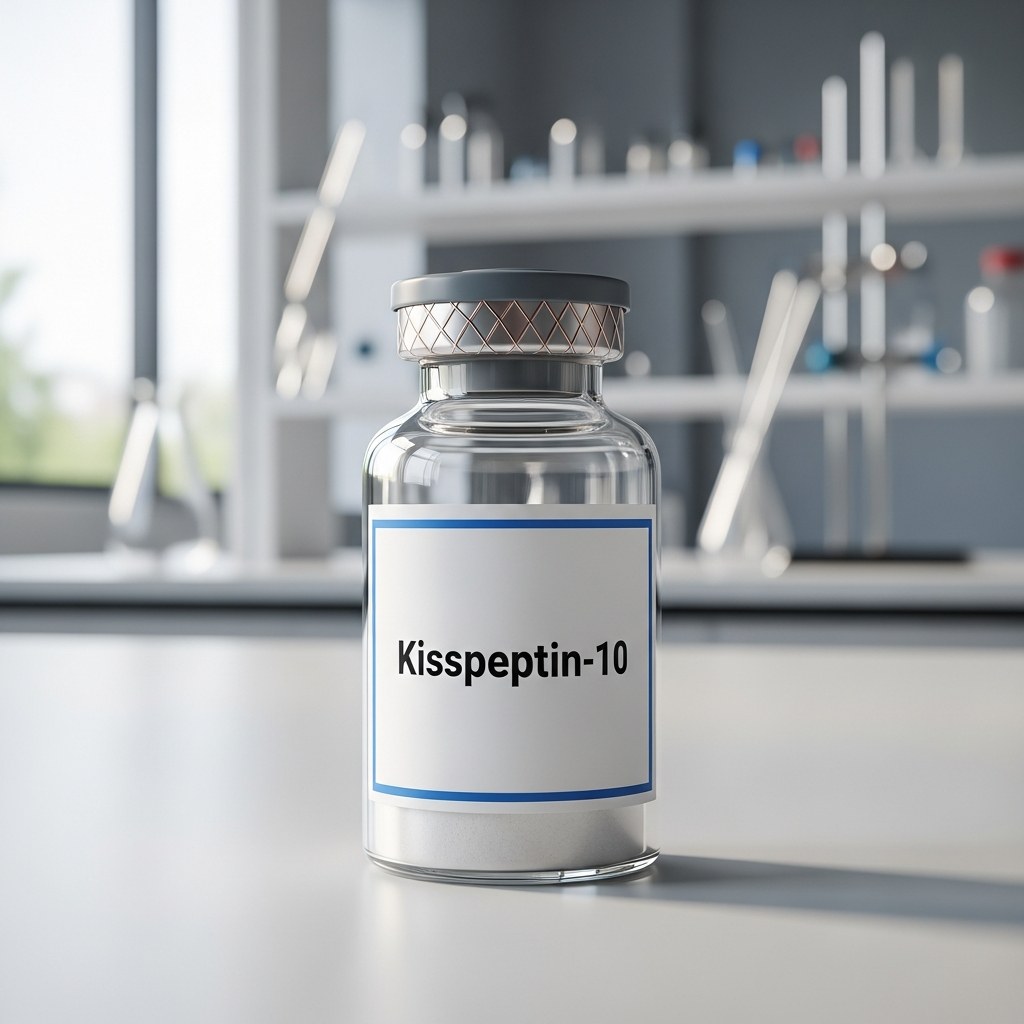
Disclaimer: This article is for educational and informational purposes only. It does not constitute medical advice. All products referenced are intended for research and laboratory use only and are not approved for human consumption.
Few molecules have rewritten reproductive neuroendocrinology as quickly as kisspeptin. Discovered as a metastasis-suppressor gene product and later found to be the single most potent known trigger of gonadotropin-releasing hormone (GnRH) release, kisspeptin-10 now sits at the center of laboratory work on puberty, fertility, and the brain circuits behind sexual and emotional processing. This guide explains what kisspeptin is, how the kisspeptin-10 peptide works at the molecular level, and why demand among researchers investigating the HPG axis is surging in 2025 and 2026. Every claim below is framed strictly for research and laboratory use only.
Key Takeaways
- What is kisspeptin? Kisspeptin is a family of peptides encoded by the KISS1 gene that act as the master upstream regulator of the hypothalamic-pituitary-gonadal (HPG) axis, the system that controls reproductive hormone output.
- Kisspeptin-10 (KP-10) is the shortest bioactive fragment, a decapeptide with the sequence Tyr-Asn-Trp-Asn-Ser-Phe-Gly-Leu-Arg-Phe-NH2, retaining full activity at the receptor despite its small size.
- It signals through GPR54 (KISS1R), a G-protein-coupled receptor expressed on GnRH neurons, making it the direct switch that initiates GnRH pulses.
- In research models, kisspeptin-10 administration drives sharp increases in luteinizing hormone (LH) and follicle-stimulating hormone (FSH), the hallmark readout used to study the axis.
- Its half-life is short (around 4 minutes intravenously), a defining feature researchers must account for in experimental design.
- Lyze Labs supplies kisspeptin-10 at 99%+ purity with published HPLC COA, trusted by 12,000+ researchers across 150+ countries.
What Is Kisspeptin? A Brief Scientific History
The KISS1 gene was first identified in 1996 as a metastasis-suppressor, and its peptide products were named after the region where the work was done. The full-length protein is cleaved into several bioactive fragments: kisspeptin-54 (KP-54), kisspeptin-14, kisspeptin-13, and kisspeptin-10 (KP-10), which corresponds to residues 45 to 54 of the parent molecule.
The molecule's reproductive significance became undeniable in 2003, when two independent research groups reported that humans carrying loss-of-function mutations in the kisspeptin receptor failed to undergo puberty and were infertile. That single observation reframed kisspeptin from an obscure tumor-suppressor into the recognized gatekeeper of reproductive maturation. Today the kisspeptin-10 peptide is one of the most studied tools in neuroendocrine laboratories worldwide.
Kisspeptin-10 Mechanism of Action at GPR54
Kisspeptin-10 is a potent agonist of GPR54, also designated KISS1R. This receptor is a class A G-protein-coupled receptor found on the surface of GnRH neurons in the hypothalamus. When kisspeptin-10 binds, it couples through Gq/11 to activate phospholipase C (PLC), generating the second messengers inositol trisphosphate (IP3) and diacylglycerol (DAG). The downstream result is intracellular calcium mobilization and protein kinase C (PKC) activation, which depolarizes GnRH neurons and triggers GnRH secretion.
In binding assays, kisspeptin-10 shows high affinity for both rat and human KISS1 receptors, with reported Ki values around 1.59 and 2.33 nM respectively. This high-affinity agonism is what makes it the most direct upstream pharmacological lever on the GnRH system available to researchers.
Role in the HPG Axis: The Upstream Switch
The HPG axis is a feedback cascade. GnRH from the hypothalamus stimulates the pituitary to release LH and FSH, which in turn act on the gonads to produce sex steroids. For decades the upstream control of GnRH pulse generation was poorly understood. Kisspeptin neurons turned out to be the missing layer.
These neurons act as the primary integrators of the axis, reading hormonal feedback signals and translating them into appropriate GnRH pulse frequency and amplitude. Because kisspeptin sits one step above GnRH, the kisspeptin-10 peptide gives researchers a way to probe the system from its highest controllable point. For broader context on how the body's growth and reproductive hormone systems interconnect, the HGH 191aa somatropin research guide and the CJC-1295 and ipamorelin stack guide cover adjacent secretagogue pathways studied in the same labs.
Kisspeptin-10 Properties at a Glance
| Property | Kisspeptin-10 (KP-10) |
|---|---|
| Sequence | Tyr-Asn-Trp-Asn-Ser-Phe-Gly-Leu-Arg-Phe-NH2 |
| Type | Decapeptide (10 amino acids) |
| Molecular formula | C63H83N17O14 |
| Molecular weight | ~1302.45 g/mol |
| CAS number | 374675-21-5 |
| Receptor target | GPR54 / KISS1R |
| Approximate Ki (human) | ~2.33 nM |
| Half-life (IV) | ~4 minutes |
| Parent gene | KISS1 |
| Research framing | Laboratory use only |
These identifiers matter for verification. A genuine certificate of analysis should list a molecular weight near 1302 g/mol and confirm the decapeptide sequence. If a vendor's COA does not match these values, treat it as a red flag, a topic covered in depth in our research peptide scam red flags guide.
Kisspeptin-10 vs Kisspeptin-54: What the Research Shows
A common question among researchers is whether the short KP-10 fragment behaves like the full-length KP-54 molecule. In receptor binding assays, the two show roughly equal potency at the KISS1 receptor despite the large difference in size, because the C-terminal decapeptide region carries the full biological activity.
The divergence appears with systemic delivery. Peripheral KP-54 stimulates LH release over a sustained period of roughly 1 to 4 hours, while KP-10 induces a less sustained LH response, typically between 10 minutes and 1 hour. This reflects KP-10's shorter half-life and faster clearance. The shorter fragment also offers practical advantages including easier synthesis and potentially improved tissue penetration, which is part of why it remains the preferred research compound.
| Feature | Kisspeptin-10 | Kisspeptin-54 |
|---|---|---|
| Length | 10 amino acids | 54 amino acids |
| Receptor potency | Comparable | Comparable |
| LH response duration | ~10 min to 1 hr | ~1 to 4 hrs |
| Half-life | Shorter (~4 min IV) | Longer (~28 min SC) |
| Synthesis | Simpler | More complex |
2025 to 2026 Research Directions
Kisspeptin research has expanded well beyond fertility. In published studies through 2025, kisspeptin administration to subjects with low sexual desire robustly enhanced sexual brain activity, with researchers observing effects on limbic structures including the amygdala, insula, and cingulate. Notably, in one randomized study, state anxiety, cortisol, and blood pressure were not significantly altered, suggesting a specific action on reproductive and motivational circuits rather than a generalized stress response.
A 2025 study reported that intranasal kisspeptin effectively stimulated LH release in healthy men, women, and subjects with hypothalamic amenorrhea, expanding the delivery routes under investigation. Other 2025 to 2026 work includes DOTA-radiolabeled KP-10 conjugates evaluated for KISS1R-targeted radiotheranostics in triple-negative breast cancer, and bioengineered extended half-life kisspeptin fusions modeled with AlphaFold 3 in complex with KISS1R. Animal-model research has also explored kisspeptin's role in precopulatory and proceptive behavior, deepening interest in its neuroendocrine reach.
This momentum, combined with surging global GLP-1 and peptide demand, is driving limited batch availability across the category. Researchers studying reproductive and hormone pathways often pair kisspeptin work with related compounds covered in the PT-141 bremelanotide research guide and the tesamorelin GHRH visceral fat research guide.
Handling, Storage, and Purity Verification
Like most peptides, kisspeptin-10 arrives as a lyophilized powder and must be reconstituted with bacteriostatic water before use in research models. Because of its short half-life and sensitivity, careful cold-chain storage is essential to preserve integrity. Our how to reconstitute research peptides and peptide storage and stability guide walk through best practices step by step.
Purity is non-negotiable for reproducible data. Every batch of the kisspeptin-10 peptide from Lyze Labs is third-party HPLC tested to 99%+ purity with a published COA and batch verification, so researchers can confirm identity and concentration before designing experiments. For a full walkthrough of reading these documents, see how to verify research peptide purity with a COA.
Why Researchers Source Kisspeptin-10 From Lyze Labs
Lyze Labs is a neutral global supplier serving 12,000+ researchers across 150+ countries with a 4.8/5 rating. Material ships free, discreetly, and worldwide in 7 to 14 days. Ordering is flexible: WhatsApp is the fastest channel, and we also accept Visa, Mastercard, UPI, PayPal, CashApp, bank or wire transfer, and crypto including BTC, USDT, and ETH. Securing your current batch locks in present pricing while limited stock lasts.
Frequently Asked Questions
What is kisspeptin and what does it do?
Kisspeptin is a peptide encoded by the KISS1 gene that functions as the master upstream regulator of the hypothalamic-pituitary-gonadal axis. In research models it activates GnRH neurons through the GPR54 receptor, which in turn drives the release of LH and FSH. It is widely studied as a tool for probing reproductive and neuroendocrine signaling.
What is the kisspeptin-10 peptide?
Kisspeptin-10, or KP-10, is the shortest bioactive fragment of the kisspeptin family, a decapeptide with the sequence Tyr-Asn-Trp-Asn-Ser-Phe-Gly-Leu-Arg-Phe-NH2. Despite its small size it retains full activity at the KISS1 receptor, making it a favored compound in laboratory studies of GnRH release and the HPG axis.
How does kisspeptin-10 affect LH and testosterone in research?
In published research, kisspeptin-10 administration produces rapid, significant increases in circulating LH and FSH by stimulating GnRH neurons. Downstream steroid changes depend on study duration, and some short-window studies report no immediate testosterone shift. All such observations are confined to research and laboratory settings, not human dosing.
What is the difference between kisspeptin-10 and kisspeptin-54?
Both fragments bind the KISS1 receptor with comparable potency, but they differ in duration. Kisspeptin-54 produces a longer LH response of roughly 1 to 4 hours, while kisspeptin-10 acts faster with a shorter window of about 10 minutes to 1 hour. Kisspeptin-10 is also simpler to synthesize, which is one reason it is the more common research compound.
Is Lyze Labs kisspeptin-10 third-party tested?
Yes. Every batch is third-party HPLC tested to 99%+ purity and ships with a published certificate of analysis and batch verification. Researchers can confirm the molecular weight near 1302 g/mol and the decapeptide sequence against the COA before beginning any study.
How fast does kisspeptin-10 ship and how can I order?
Lyze Labs offers free discreet worldwide shipping in 7 to 14 days. WhatsApp is the fastest order channel, and we also accept Visa, Mastercard, UPI, PayPal, CashApp, bank or wire transfer, and crypto including BTC, USDT, and ETH.
Secure Your Kisspeptin-10 Batch
Demand for HPG-axis research material is climbing fast and batches are limited. Lock in current batch pricing on the kisspeptin-10 peptide today. Message us on WhatsApp for the fastest turnaround, or place your order through any of our supported payment methods for free discreet worldwide delivery.
Related Research Guides
PT-141 (Bremelanotide): Melanocortin Pathway Research Guide
A research-focused overview of PT-141 (Bremelanotide), the synthetic melanocortin receptor agonist studied for its central action on arousal pathways. Covers MC3R/MC4R mechanism, how it differs from peripheral PDE5 compounds, and what defines laboratory-grade material.
Trevogrumab vs Garetosmab vs Bimagrumab vs Apitegromab: The 2026 Myostatin Inhibitor Comparison
Four monoclonal antibodies, one pathway, four different points of attack. What trevogrumab, garetosmab, bimagrumab and apitegromab each bind, what the 2026 trial data shows, and how to choose between a ligand trap and a receptor blocker.

How to Choose a Research Peptide Supplier: The 2026 Verification Checklist
A practical 2026 framework for choosing a research peptide supplier: lot-matched HPLC COAs, mass-spec identity, batch transparency, and the verification steps that separate a legit peptide source from a forged one.