Comparisons
NAD+ vs NMN vs NR: The Coenzyme and Its Two Building Blocks
NAD+ is the coenzyme every cell needs. NMN and NR are building blocks cells turn into NAD+. Here is how the three differ, what the human trials found, and which fits which research question.
LyzeLabs Research Team · Updated · 4 min read
In this guide
NAD+ (nicotinamide adenine dinucleotide) is a coenzyme found in every living cell. Cells use it to turn food into energy, and enzymes that repair DNA and manage stress, such as sirtuins and PARPs, use it up as fuel. Its level falls with age, in rodents and in humans (Covarrubias, 2021).
NMN and NR are two building blocks that cells turn into NAD+. NR is the smaller one: cells turn NR into NMN, and NMN into NAD+. So the three sit on one short path, NR → NMN → NAD+, and the right choice depends on which step your study is about.
The Short Answer
- NAD+ is the active coenzyme itself. It is the direct tool when NAD+ is the variable you want to change and measure.
- NMN (nicotinamide mononucleotide) is one step before NAD+. In a 10-week trial in women with prediabetes, NMN improved how well muscle responded to insulin (Yoshino, 2021).
- NR (nicotinamide riboside) is two steps before NAD+. Taken by mouth, it raised the NAD+ system in human blood, more at higher amounts (Trammell, 2016), and six weeks of it was well tolerated by middle-aged and older adults (Martens, 2018).
What NAD+ Does
NAD+ has two jobs. First, it carries electrons in the reactions that turn food into energy, which makes it central to metabolism. Second, a group of enzymes uses it up: sirtuins, PARPs (which repair DNA) and CD38. Through them, NAD+ affects DNA repair, how cells age, how genes are packed, and how immune cells work (Covarrubias, 2021).
Because those enzymes consume it, cells constantly rebuild NAD+ from smaller pieces. NR and NMN are two of those pieces, which is why both are studied as ways to raise NAD+ levels. For the full story, see the NAD+ guide.
Side-by-Side Comparison
| Feature | NAD+ | NMN | NR |
|---|---|---|---|
| What it is | The active coenzyme | Building block, one step before NAD+ | Building block, two steps before NAD+ |
| Size | ~663 Da | ~334 Da | ~255 Da |
| Human data highlight | Falls with age (review of human and animal data) | 10-week trial: better muscle response to insulin | Raised blood NAD+ markers; 6-week trial well tolerated |
| Best for | Studies where NAD+ itself is the variable | Studies of the NMN step | Studies of the NR step and oral precursors |
Which One Fits Which Research Question?
Choose NAD+ when the coenzyme itself is what your study needs: enzyme work with sirtuins or PARPs, which run on NAD+ directly, or studies where NAD+ is the starting material. In cells and animals, measure NAD+ in the tissue you care about rather than assuming how much reaches it.
Choose NMN or NR when the conversion is part of the question: how well a tissue builds NAD+, or how a building block taken by mouth changes NAD+ levels in the body.
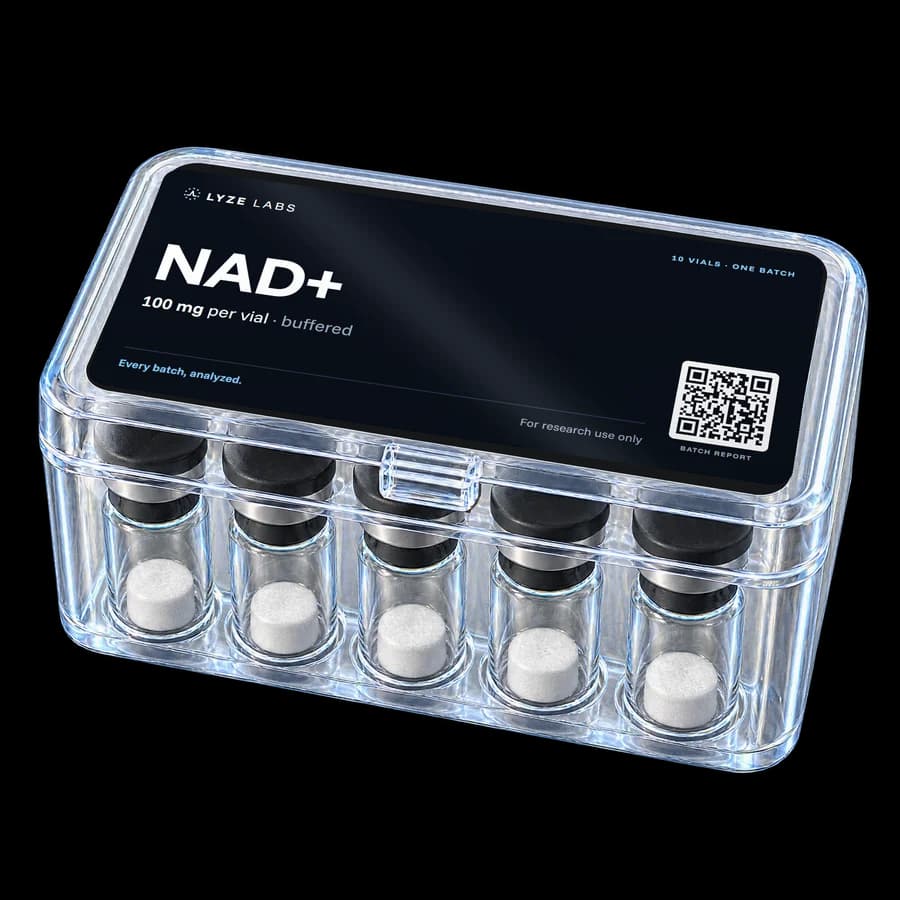
We supply NAD+ itself: NAD+ Buffered, in ten-vial kits of 100, 500 or 1,000 mg.
A caution from the 2021 review: raising NAD+ is not the same as proving a benefit. Open questions remain on how best to restore NAD+ with age, whether doing so is safe, and whether it helps aging humans (Covarrubias, 2021).
Handling NAD+
NAD+ arrives as freeze-dried powder and mixes with bacteriostatic water. Its vials hold far more powder than most peptide vials, from 100 to 1,000 mg, so plan the water volume before you mix. Keep mixed vials in the fridge. See how to reconstitute research peptides and the storage guide.
Frequently Asked Questions
Is NMN better than NAD+?
They are different tools. NAD+ is the active coenzyme. NMN is a building block that cells turn into NAD+. If NAD+ itself is your variable, NAD+ is the direct choice. If the conversion step is part of your question, NMN is.
What is the difference between NMN and NR?
NR sits one step further back. Cells turn NR into NMN, and NMN into NAD+. Both raise NAD+ levels; they enter the path at different points.
Does NAD+ really fall with age?
Yes. A 2021 review found a gradual fall in NAD+ in tissues and cells with age, in rodents and in humans, linked to many age-related diseases.
Has NMN been studied in people?
Yes. In a 10-week trial in postmenopausal women with prediabetes, NMN improved how muscle responded to insulin compared with placebo.
Has NR been studied in people?
Yes. NR raised blood NAD+ markers in a clear, amount-dependent way, and a 6-week trial in middle-aged and older adults found it well tolerated.
Studies Cited
- Covarrubias AJ, et al. (2021). NAD+ metabolism and its roles in cellular processes during ageing. Nature Reviews Molecular Cell Biology.
- Yoshino M, et al. (2021). Nicotinamide mononucleotide increases muscle insulin sensitivity in prediabetic women. Science.
- Trammell SA, et al. (2016). Nicotinamide riboside is uniquely and orally bioavailable in mice and humans. Nature Communications.
- Martens CR, et al. (2018). Chronic nicotinamide riboside supplementation is well-tolerated and elevates NAD+ in healthy middle-aged and older adults. Nature Communications.
This guide is for education. It is not medical advice. Every compound we supply is for laboratory research only and is not for human use.