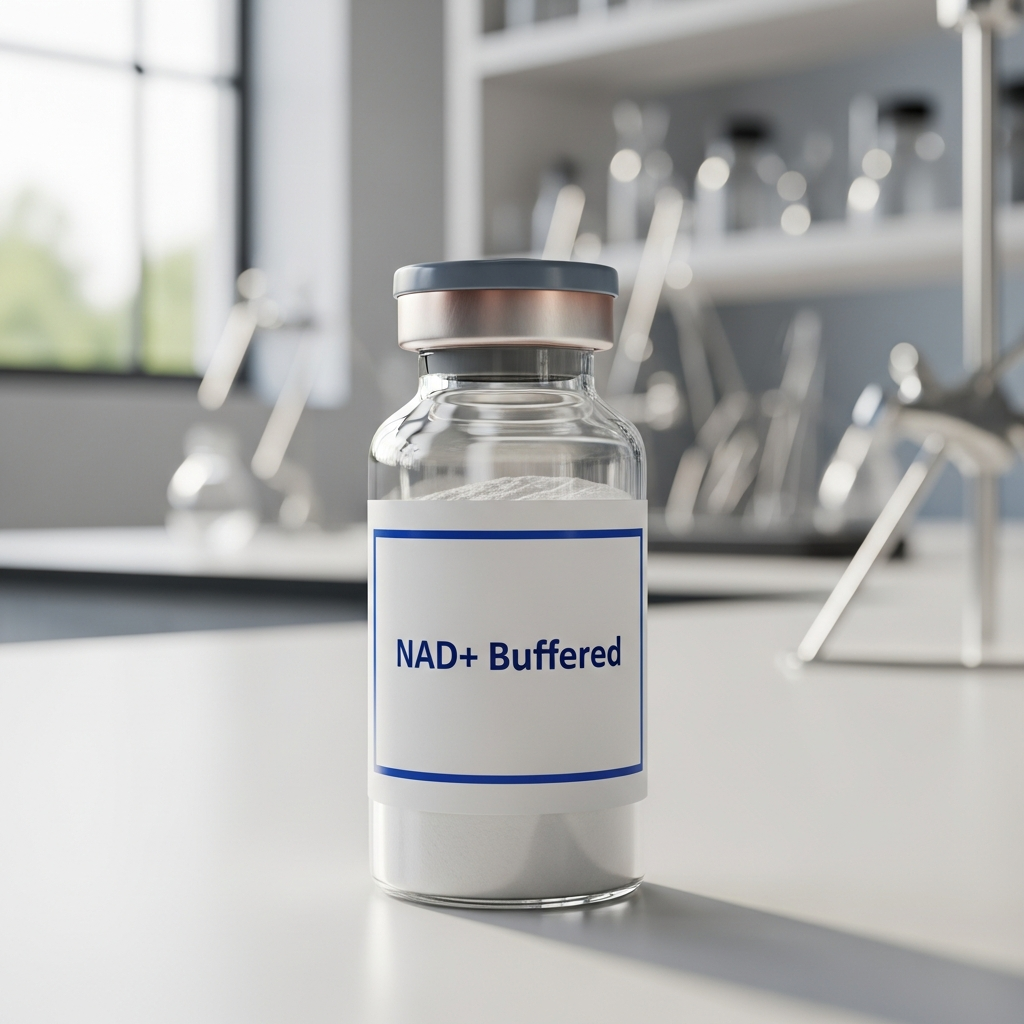
NAD+ (Buffered): The Cellular Longevity Research Guide
A research-focused guide to NAD+ (buffered), the coenzyme at the center of cellular energy, sirtuin signaling, and DNA repair. Covers mechanism, age-related decline, how NAD+ compares to Epitalon and MOTS-c for longevity research, and what to verify on a certificate of analysis before sourcing.
Disclaimer: This article is for educational and informational purposes only. It does not constitute medical advice. All products referenced are intended for research and laboratory use only and are not approved for human consumption.
Few molecules sit closer to the center of longevity research than NAD+. Nicotinamide adenine dinucleotide is the coenzyme that powers cellular energy production, fuels the sirtuin "longevity enzymes," and supplies the substrate that DNA-repair machinery burns through every time a cell fixes damage. Its levels fall sharply with age, and that decline has made NAD+ one of the most studied subjects in cellular aging laboratories worldwide. This guide explains what NAD+ is, why researchers are interested, how the buffered form solves a real handling problem, and how NAD+ compares to other longevity compounds such as Epitalon and MOTS-c. Everything below is framed strictly for laboratory and research use only.
Key Takeaways
- NAD+ (nicotinamide adenine dinucleotide, CAS 53-84-9, molecular weight 663.4 anhydrous) is a coenzyme central to mitochondrial energy metabolism, sirtuin signaling, and DNA repair in research models.
- Published data indicate cellular NAD+ levels decline roughly 50% every 20 years after age 30, a pattern that has anchored the "NAD+ decline" hypothesis of aging.
- Sirtuins are NAD+-dependent enzymes that consume one full NAD+ molecule per reaction, which is why NAD+ availability is treated as a rate-limiting input in longevity research.
- The "buffered" designation means the compound is pH-neutralized for use in laboratory solution, which addresses the acidity and handling difficulty of raw NAD+.
- In longevity research, NAD+ targets the energy and repair axis, Epitalon targets telomere biology, and MOTS-c targets mitochondrial exercise-mimetic pathways.
- Quality matters: look for a batch certificate of analysis (COA), HPLC verification, and purity above 99% before sourcing any NAD+ for laboratory work.
What NAD+ Is and How It Works
NAD+ is a dinucleotide built from a nicotinamide group and an adenine group joined through two phosphates, with the molecular formula C21H28N7O14P2+. It exists in two states: the oxidized form NAD+ and the reduced form NADH. This pair acts as the cell's primary electron shuttle, accepting electrons during the breakdown of fuel and delivering them to the mitochondrial electron transport chain where ATP is generated. Without adequate NAD+, the entire energy-production cascade slows.
Beyond energy transfer, NAD+ has a second role that drives most longevity interest: it is a consumable substrate. Three families of enzymes spend NAD+ as fuel. Sirtuins use it to remove acetyl groups from proteins and regulate gene expression. PARPs (poly-ADP-ribose polymerases) use it to flag and repair DNA strand breaks. CD38 consumes it during immune and signaling activity. Because these enzymes burn through NAD+ rather than recycle it, NAD+ supply and demand are constantly competing inside the cell. Research models suggest that as DNA damage accumulates with age, PARP activity rises and draws down the shared NAD+ pool, leaving less available for sirtuins.
Why Researchers Are Interested in NAD+
The most cited driver of NAD+ research is the so-called NAD+-sirtuin axis. Sirtuins are a family of seven NAD+-dependent enzymes implicated in energy metabolism, DNA repair, inflammation, cellular senescence, oxidative stress response, and mitochondrial biogenesis. The working hypothesis in aging research is straightforward: as NAD+ falls, sirtuin activity falls with it, and several hallmarks of aging follow.
The decline itself is well documented. Published work indicates NAD+ concentrations drop by approximately half every two decades after age 30, correlating with reduced mitochondrial function and increased accumulated DNA damage in tissue samples. This has made restoring or maintaining NAD+ a central question across longevity laboratories. Human studies using NAD+ precursors such as nicotinamide riboside (NR) and nicotinamide mononucleotide (NMN) have shown blood NAD+ can be raised roughly 1.5 to 2.7 times baseline, and researchers continue to investigate what metabolic outcomes follow that elevation. NAD+ now has one of the deepest research bases of any longevity compound, with hundreds of indexed studies spanning cellular, animal, and human work, which is why it is often classified as having emerging clinical evidence rather than purely preclinical interest. For researchers studying related pathways, our Epitalon longevity research guide covers a complementary telomere-focused mechanism.
NAD+ vs Epitalon vs MOTS-c for Longevity Research
A frequent question in longevity laboratories is how NAD+ relates to the two best-known longevity peptides, Epitalon and MOTS-c. They are not interchangeable. Each targets a distinct layer of the aging process, which is why research groups often study them as separate variables rather than substitutes.
| Compound | Primary research target | Mechanism focus | Evidence depth |
|---|---|---|---|
| NAD+ (buffered) | Cellular energy, sirtuins, DNA repair | NAD+-dependent enzyme substrate | Emerging clinical, hundreds of studies |
| Epitalon | Telomere biology | Telomerase activation in vitro | Preclinical and animal longevity data |
| MOTS-c | Mitochondrial metabolism | Exercise-mimetic signaling | Preclinical, limited human data |
NAD+ sits at the metabolic and repair core, supplying the substrate that sirtuins and PARPs depend on. Epitalon is a short synthetic peptide studied for its reported ability to activate telomerase and influence telomere length in laboratory models, a fundamentally different axis. MOTS-c is a 16-amino-acid peptide encoded in the mitochondrial genome itself that behaves as a systemic signal and is frequently described as an exercise mimetic in research settings. Because the three operate on energy and repair, chromosome ends, and mitochondrial signaling respectively, many longevity researchers treat them as parallel tools rather than competitors. To go deeper on the mitochondrial-derived peptide angle, researchers can compare notes against published MOTS-c literature alongside this guide.
What "Buffered" Means and Why It Matters
Raw NAD+ in solution is acidic and, in research handling, that acidity is a real obstacle. The buffered designation means the compound has been formulated so that, once reconstituted, the resulting solution sits closer to neutral pH rather than the harsh low pH of unbuffered NAD+. For laboratory work this matters for two reasons. First, neutral-pH preparation is gentler on the molecule and reduces certain degradation pathways. Second, in any model where local pH matters, an unbuffered acidic solution introduces a confounding variable that buffered NAD+ avoids. The buffered form is simply a more controlled starting material for researchers who need reproducible conditions.
Reconstitution and Storage Notes for Research Settings
NAD+ is a hygroscopic white powder that is highly water-soluble and stable when stored dry and dark. The research consensus on handling is consistent across the literature. The dry powder should be stored sealed and desiccated, ideally at -20C or colder, where it remains stable long term. Reconstitution should use a neutral-pH aqueous buffer with gentle mixing, never vigorous agitation, because aggressive shaking can accelerate degradation. After reconstitution, single-use aliquoting and protection from light are standard, since NAD+ is susceptible to hydrolysis at alkaline pH, oxidation, and photodegradation in solution.
Buffer choice influences stability in measurable ways. Recent stability work found NAD+ and NADH were highly stable in Tris buffer, with markedly higher degradation rates observed in sodium phosphate or HEPES buffers. For research planning, that finding is worth weighing when designing extended-stability experiments. For step-by-step technique, our how to reconstitute research peptides guide and the peptide storage and stability guide cover the fundamentals that apply equally to NAD+.
What to Verify Before Sourcing NAD+
Because NAD+ is hygroscopic and degradation-prone, sourcing quality is not optional for reliable research. The single most important document is a batch-specific certificate of analysis. A credible COA shows HPLC purity results, identity confirmation, and a purity figure that should exceed 99%. Mass spectrometry confirmation of molecular weight (663.4 anhydrous, 681.4 monohydrate) adds further assurance that the material is genuine NAD+ and not a precursor or a degraded lot.
Lyze Labs supplies NAD+ (buffered) as pharmaceutical-grade material, third-party HPLC tested, with a COA available per batch and purity above 99%. Every lot is verified before it ships. Researchers who want to understand exactly what a clean COA looks like should read our how to verify research peptide purity with a COA guide, and to avoid bad actors, the research peptide scam red flags breakdown is essential reading before any purchase.
Demand for NAD+ and related longevity compounds has surged alongside global interest in cellular aging research, and batch availability of high-purity buffered material can tighten quickly. Securing current batch pricing while a verified lot is in stock is the practical move for any lab running a defined study timeline.
Frequently Asked Questions
What is NAD+ used for in research?
In laboratory settings, NAD+ is studied as a coenzyme central to mitochondrial energy production, sirtuin enzyme activity, and DNA repair. Researchers investigating cellular aging use it to probe the NAD+-sirtuin axis, the relationship between NAD+ decline and accumulated DNA damage, and metabolic outcomes in cellular and animal models. It is supplied strictly for research and laboratory use only.
Why is NAD+ sold as a buffered form?
Unbuffered NAD+ produces an acidic solution that is harsh to work with and introduces pH as a confounding variable. The buffered form is pH-neutralized so that the reconstituted solution sits closer to neutral, giving researchers a more controlled and reproducible starting material and reducing certain degradation pathways during handling.
How does NAD+ compare to NMN and NR?
NMN and NR are NAD+ precursors that cells convert into NAD+ through enzymatic steps, and most published human trial data uses these oral precursors. Direct NAD+ is the active coenzyme itself rather than a precursor that requires conversion. In research, the choice between them depends on whether the study design calls for the finished coenzyme or its upstream building blocks.
How should NAD+ be stored in a laboratory?
The dry powder is hygroscopic and should be kept sealed, desiccated, and dark, ideally at -20C or colder, where it is stable long term. Once reconstituted in a neutral-pH buffer, it should be aliquoted into single-use volumes, protected from light, and handled gently, since NAD+ degrades through hydrolysis, oxidation, and photodegradation in solution.
What purity should research-grade NAD+ have?
Research-grade NAD+ should be verified above 99% purity by HPLC, with a batch-specific certificate of analysis confirming identity and purity. Mass spectrometry confirmation of the molecular weight adds further assurance. Lyze Labs NAD+ (buffered) is third-party HPLC tested with a COA available per batch.
Does Lyze Labs ship NAD+ worldwide?
Yes. Lyze Labs offers free discreet worldwide shipping with typical delivery in 7 to 14 days, trusted by more than 12,000 researchers across 50-plus countries. Orders can be placed fastest over WhatsApp, and the company also accepts Visa, Mastercard, UPI, PayPal, CashApp, bank or wire transfer, and crypto including BTC, USDT, and ETH.
Secure Your NAD+ (Buffered) Batch
If your research calls for high-purity, pH-neutralized NAD+ backed by a per-batch COA and 99%+ HPLC verification, order NAD+ (buffered) from Lyze Labs today. Message us on WhatsApp for the fastest response and current batch pricing, with free discreet worldwide shipping and delivery in 7 to 14 days. For broader context on the longevity space, see our Epitalon longevity research guide to round out your study planning.
Related Research Guides
MOTS-c: The Mitochondrial-Derived Peptide Research Guide
MOTS-c is a 16-amino-acid mitochondrial-derived peptide that activates AMPK and mimics many of the metabolic signals of exercise in research models. This guide covers its mechanism, key findings, how it compares to SS-31 and 5-Amino-1MQ, and what to verify before sourcing for laboratory work.
Epitalon: The Four Amino Acid Peptide Longevity Research Will Not Stop Talking About
Four amino acids. A Russian research lineage spanning three decades. A mechanism story involving telomeres, telomerase, and the pineal gland. Epitalon is the most interesting peptide in the longevity catalog, and the most misunderstood.

How to Choose a Research Peptide Supplier: The 2026 Verification Checklist
A practical 2026 framework for choosing a research peptide supplier: lot-matched HPLC COAs, mass-spec identity, batch transparency, and the verification steps that separate a legit peptide source from a forged one.