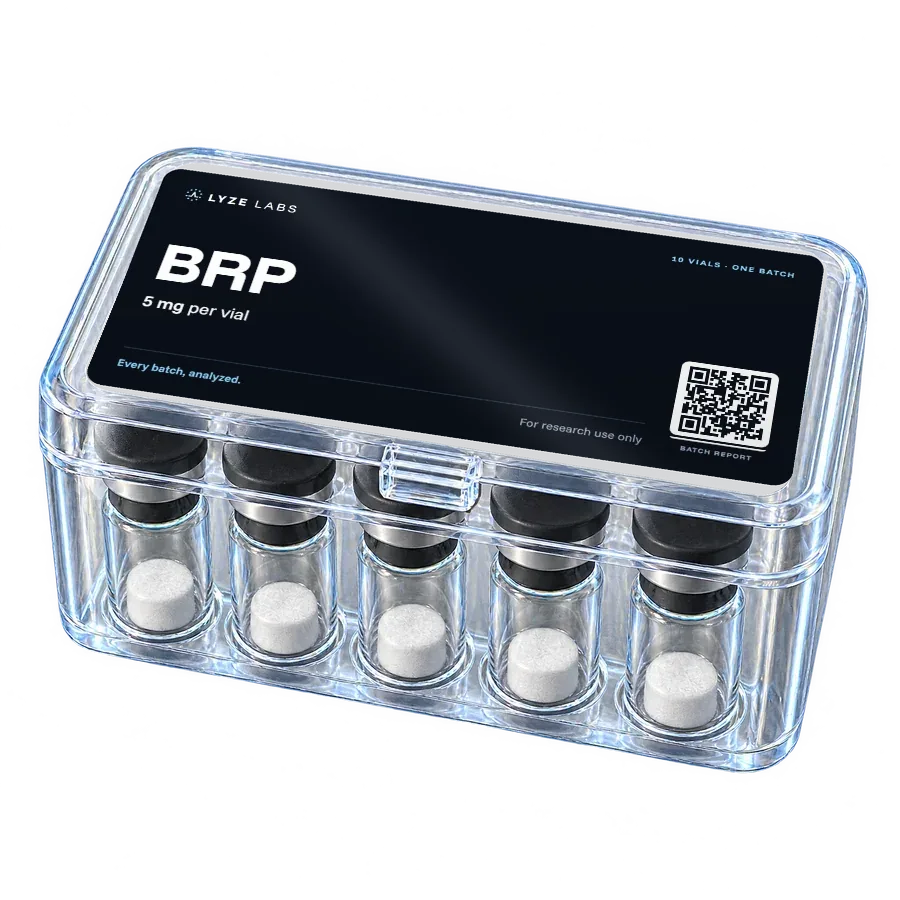
BRP
BRP is a 12-amino-acid appetite peptide discovered at Stanford in 2025. Each kit is 10 vials from one batch, 5 or 10 mg a vial.
10 vials from one batchFreeze-dried powder4.8 on Trustpilot
Also known as BRINP2-related peptide
For research and laboratory use only. Not for human consumption.
- Batch
- Delivery
- Free tracked shipping to 150+ countries. Delivery guaranteed. How delivery works
- Report
- Batch report after the first test · Delivery photos
- Guarantee
- Once this compound's first Certificate of Analysis is published at /lab-results, the same below-COA-purity reship guarantee applies.
- Help
- A person answers on WhatsApp, even at 3 a.m. your time.
BRP: Key Facts
BRP is a weight loss research peptide supplied by LyzeLabs as a lyophilized reference standard, strictly for laboratory research use. It is available in 2 formats. Batch certificates of analysis are published on the lab-results page as verification completes.
| Compound | BRP |
|---|---|
| Research category | GLP-1 and metabolic |
| Available formats | 5mg*10vials, 10mg*10vials |
| Strength shown | 5 mg |
| Purity | Published on the lab-results page as verification completes |
| Test method | HPLC + mass spectrometry |
| Certificate of analysis | Published on the lab-results page after the first test |
| Intended use | Laboratory research use only. Not for human consumption. |
| Handling | Supplied lyophilized, store per the stability guide |
Good to know
All ten vials are from one batch. One batch report covers the whole kit, so the first vial matches the last.
Your price drops with every kit. Any mix counts, up to 42% off at 50 kits.
About This Product
What is BRP?
BRP, short for BRINP2-related peptide, is a peptide of 12 amino acids. Stanford researchers found it in 2025. A computer predicted which pieces the body's own enzymes cut from larger proteins, and the team tested the pieces.
Out of more than 2,600 candidate fragments, BRP stood out: it made animals eat less.
How does BRP work?
- Brain signal: it switches on appetite-related areas of the brain.
- A new route: it works without the leptin, GLP-1 and MC4R pathways most weight compounds use.
- No nausea seen: in mice and pigs it cut food intake without signs of nausea or aversion.
What do researchers study it for?
- Appetite and food intake
- Obesity models
- Weight-loss routes outside GLP-1
- Finding new peptide hormones
Key studies
- Prohormone cleavage prediction uncovers a non-incretin anti-obesity peptide (Nature, 2025). The discovery of BRP: less food intake and weight in mice and pigs, independent of GLP-1. It is the founding study.
Status (November 2026)
Preclinical; no human trials reported.
Quality Standards
- Form: freeze-dried powder in sealed vials
- Storage: refrigerator for near-term use, minus 20 degrees Celsius long-term
- Batch report: goes up on /lab-results once testing of the first batch is complete
Related research
- Retatrutide, Survodutide and Cagrilintide, the hormone routes BRP does not use.
For research purposes only. Not for human consumption or therapeutic use.
Research Context for BRP
Metabolic and Weight Loss Research Context
This compound sits in the incretin and metabolic peptide class, where research focuses on appetite regulation, glucose handling, energy expenditure, and the complex signaling network that connects gut, pancreas, liver, and hypothalamus. Research protocols in this category typically involve dose escalation, tolerability mapping, and long-duration observation of metabolic endpoints.
BRP ships as a lyophilized research reagent through the LyzeLabs™ catalog in the GLP-1 and metabolic category, with 2 variant options sized to different research protocols. Verified LyzeLabs compounds publish their full HPLC chromatogram and mass spectrometry confirmation for each batch on the LyzeLabs lab results page; this compound's analytical data is published there as it completes verification.
Related Research Guides
Retatrutide vs Tirzepatide vs Semaglutide
Full receptor-level comparison of the three leading metabolic peptides with a decision framework for research protocols.
How to Read a Peptide Certificate of Analysis
The verification routine every research lab should run before accepting a vial.
How to Reconstitute a Research Peptide
The nine-step procedure, common mistakes, and per-compound notes for clean reconstitution.
Other Compounds in the GLP-1 and metabolic Category
Research Tools for This Compound
Frequently Asked Questions
What is BRP?
BRINP2-related peptide, a 12-amino-acid peptide discovered at Stanford in 2025 that lowered food intake in mice and pigs.
BRP vs GLP-1 compounds: what is the difference?
GLP-1 compounds act on the GLP-1 receptor. BRP lowered food intake in animals through a different route, without the GLP-1, leptin or MC4R pathways.
Has BRP been tested in people?
No human trials have been reported as of November 2026. The founding study tested it in mice and pigs.
What comes in a BRP kit?
Ten sealed vials of freeze-dried BRP, all from one batch, at 5 mg or 10 mg a vial.
How should BRP be stored?
Keep the sealed vials at -20°C. Once mixed, keep it at 2 to 8°C and use it within 14 days.
How does BRP ship?
BRP ships as a freeze-dried powder in sealed vials, which stays stable at room temperature for the trip. Every order goes out in plain packaging with tracking, and most arrive in 7 to 14 days. Store it in the freezer at -20°C once it arrives.
1 kit
$415