AOD-9604 Research Guide: The HGH Fragment 176-191 Fat-Loss Peptide Explained
A research-grade guide to AOD-9604, the modified HGH fragment 176-191 peptide studied for lipolysis without growth hormone effects. Mechanism, study findings, structure, and how it compares to Fragment 176-191, with sourcing and purity guidance for laboratory researchers.
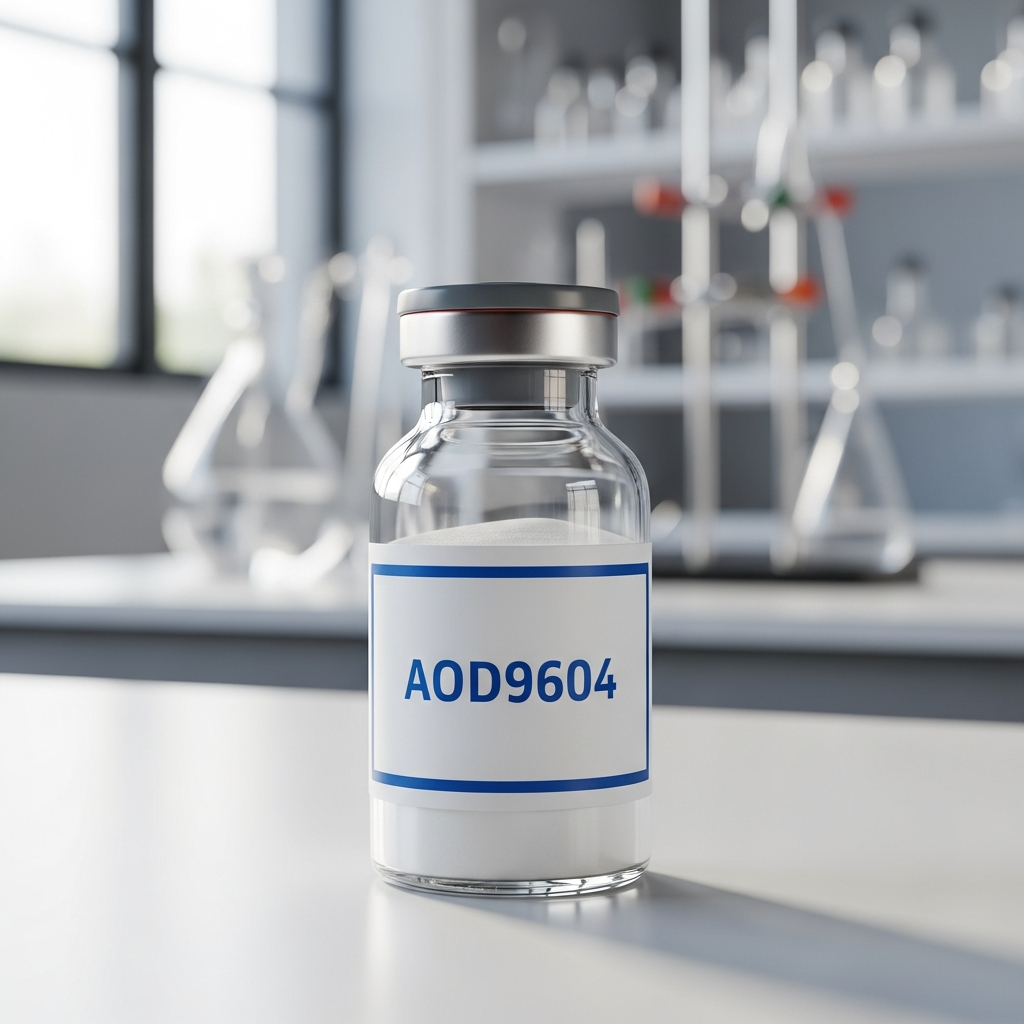
Disclaimer: This article is for educational and informational purposes only. It does not constitute medical advice. All products referenced are intended for research and laboratory use only and are not approved for human consumption.
AOD-9604 is one of the most studied fat-metabolism research peptides of the last two decades, and interest from laboratory researchers has surged alongside the broader GLP-1 and peptide demand wave of 2025 and 2026. Built from the C-terminal tail of human growth hormone, AOD 9604 was engineered to isolate the lipolytic signal of HGH while leaving out the systemic growth and blood-sugar effects of the full hormone. This guide covers what AOD-9604 actually is at the molecular level, what the published research shows about lipolysis, how it differs from HGH Fragment 176-191, and what to verify before sourcing a research-grade product. Everything here is framed strictly for research and laboratory use only.
Key Takeaways
- AOD-9604 is a 16-amino-acid synthetic peptide derived from the C-terminal region (residues 176 to 191) of human growth hormone, with an added N-terminal tyrosine. CAS 221231-10-3, molecular weight approximately 1815 g/mol.
- In research models it is studied for stimulating lipolysis (fat breakdown) and reducing lipogenesis (fat storage), reportedly through beta-3 adrenergic receptor signaling, without binding the growth hormone receptor and without elevating IGF-1.
- AOD 9604 and HGH Fragment 176-191 are close relatives. The key structural difference is a disulfide bridge and N-terminal tyrosine in AOD-9604 that improve plasma stability.
- AOD-9604 progressed through formal preclinical toxicology and six human clinical trials involving over 900 participants, with a strong tolerability profile but inconsistent weight-loss efficacy signals.
- It holds GRAS status in some contexts, though it has not been evaluated by the FDA as a drug, and it remains a research compound, not an approved therapy.
- For laboratory work, third-party HPLC testing, a published COA, and confirmed 99%+ purity are the non-negotiable checks before sourcing.
What Is AOD-9604?
AOD-9604 (the name stands for Anti-Obesity Drug 9604) is a synthetic peptide fragment that reproduces the lipolytic tail of human growth hormone. The full HGH molecule is 191 amino acids long, and decades of research narrowed the fat-metabolism activity down to a short C-terminal segment. AOD 9604 captures that segment, residues 176 to 191, and adds a tyrosine residue at the N-terminus to support stability and handling.
The result is a compact 16-amino-acid peptide with the molecular formula C78H123N23O23S2 and a molecular weight near 1815 g/mol. Its sequence (H-Tyr-Leu-Arg-Ile-Val-Gln-Cys-Arg-Ser-Val-Glu-Gly-Ser-Cys-Gly-Phe-OH) features a disulfide bridge between the two cysteine residues, which is one of the reasons it behaves differently from a plain unmodified fragment. AOD-9604 was originally developed by Metabolic Pharmaceuticals in Australia in the 1990s, making it one of the more thoroughly characterized fat-loss peptides available to researchers.
Because it was designed to keep the lipolytic action of growth hormone while removing the growth-promoting and insulin-affecting actions, AOD 9604 has become a reference compound for studying targeted fat metabolism in isolation.
How AOD-9604 Works in Research Models
The mechanism that makes AOD-9604 interesting is what it does NOT do as much as what it does. Full-length HGH works largely through the growth hormone receptor, driving IGF-1 production and a cascade of systemic effects. In published research, AOD-9604 does not appear to bind the growth hormone receptor in any meaningful way, and it does not raise IGF-1 levels.
Instead, the proposed mechanism centers on beta-3 adrenergic receptor (beta-3 AR) signaling, which is concentrated in adipose tissue. In research models, AOD 9604 is studied for two complementary actions: stimulating lipolysis, the breakdown of stored triglycerides into free fatty acids, and inhibiting lipogenesis, the formation and storage of new fat. In obese rodent models, chronic administration was associated with reduced weight gain and increased fat oxidation, with beta-3 AR involvement repeatedly implicated.
This receptor-level selectivity is the core scientific appeal. Researchers investigating fat metabolism can study a lipolytic signal without simultaneously triggering the growth, fluid-retention, and glucose effects that complicate work with full growth hormone. For deeper background on growth-hormone-axis compounds, see the HGH 191aa somatropin research guide and the IGF-1 LR3 muscle hyperplasia guide.
AOD-9604 vs HGH Fragment 176-191
The single most common question buyers ask is how AOD 9604 differs from HGH Fragment 176-191. The two are close relatives, and in casual conversation the names are sometimes used interchangeably, but they are not identical molecules. The differences matter for any researcher comparing them in vitro.
| Property | AOD-9604 | HGH Fragment 176-191 |
|---|---|---|
| Core sequence | HGH residues 177 to 191 plus N-terminal tyrosine | Native HGH residues 176 to 191, unmodified |
| Structural modification | Added tyrosine and disulfide bridge cyclization | Linear, no added residues |
| Plasma stability | More resistant to enzymatic breakdown | Degrades faster as a linear peptide |
| Proposed mechanism | Beta-3 adrenergic, lipolysis and reduced lipogenesis | Same general beta-3 adrenergic pathway |
| Development depth | Six human trials, formal toxicology, 900+ participants | Thinner formal evidence base |
| GH receptor binding | Negligible, no IGF-1 elevation | Negligible, no IGF-1 elevation |
In short, HGH Fragment 176-191 is the straightforward native sequence reproduced in a lab, while AOD-9604 is the optimized, formally developed analog. The disulfide bridge and tyrosine addition in AOD 9604 are designed to make the peptide more stable in plasma, which historically created challenges for consistent dosing with the unmodified fragment. Both compounds are believed to act through the same beta-3 adrenergic pathway, so the pharmacology is similar, but AOD-9604 carries the heavier development pedigree.
What the Clinical Research Actually Shows
AOD-9604 is unusual among research peptides because it went through a genuine pharmaceutical development program. It completed formal preclinical toxicology studies and six human clinical trials involving more than 900 participants. That depth of human data is rare in this space.
The consistent finding across those trials was a strong safety and tolerability profile over the studied periods. AOD 9604 was generally well tolerated, and importantly it did not produce the IGF-1 elevation or glucose disturbances seen with growth hormone. This clean tolerability signal is a large part of why the compound later received GRAS (Generally Recognized As Safe) status in certain contexts.
The efficacy picture is more nuanced and worth stating plainly. While early preclinical and some clinical signals around fat oxidation were encouraging, the weight-loss efficacy results across the full set of human trials were inconsistent. Some protocols showed measurable effects, others did not separate clearly from placebo. This is exactly why AOD-9604 remains a research compound rather than an approved obesity therapy. Researchers studying it today are typically investigating mechanism, formulation, and combination questions rather than treating it as a settled fat-loss agent. None of this constitutes medical guidance, and AOD 9604 has not been evaluated by the FDA as a drug.
Handling, Reconstitution, and Storage
AOD-9604 ships as a lyophilized (freeze-dried) powder, which is the most stable form for transport and long-term storage. Before any in vitro assay, the powder must be reconstituted into solution. AOD 9604 dissolves well in aqueous solvents, and bacteriostatic or sterile water is the standard choice for laboratory reconstitution and short-term storage.
For storage, the lyophilized powder should be kept sealed, dry, and protected from light, with -20C recommended for long-term preservation. Sealed and dry, shelf life is typically up to 12 months. Once reconstituted, the solution should be refrigerated and used within a shorter window to preserve peptide integrity.
Proper handling is what separates reliable data from wasted material. For step-by-step technique, our how to reconstitute research peptides guide and the peptide storage and stability guide cover dilution math, solvent selection, and degradation factors in detail. Getting reconstitution right is especially important with stability-sensitive fragments.
How to Source Research-Grade AOD-9604
Surging peptide demand has pulled a wave of low-quality suppliers into the market, so verification is non-negotiable. The four signals that matter most are third-party HPLC testing, a published certificate of analysis (COA), confirmed purity of 99% or higher, and batch-level traceability so the vial you receive matches the data you were shown.
Every batch of AOD-9604 from Lyze Labs is third-party HPLC tested with a published COA and verified 99%+ purity, so researchers can confirm identity and concentration before any work begins. To learn how to read a COA yourself, see how to verify research peptide purity with a COA, and to spot bad actors before you buy, read the research peptide scam red flags guide.
Lyze Labs is trusted by more than 12,000 researchers across 50 or more countries and holds a 4.8 out of 5 rating. Ordering is fastest over WhatsApp, with payment accepted via Visa and Mastercard, UPI, PayPal, CashApp, bank or wire transfer, and crypto including BTC, USDT, and ETH. Shipping is free, discreet, and worldwide, typically arriving in 7 to 14 days. Batch availability on high-demand fat-metabolism peptides is limited, so securing current batch pricing early is the practical move for any lab planning ongoing work.
Frequently Asked Questions
What is AOD 9604 peptide used for in research?
AOD 9604 peptide is studied in laboratory and research models for its effects on fat metabolism, specifically lipolysis (fat breakdown) and reduced lipogenesis (fat storage). It is a research compound used to investigate the lipolytic signal of growth hormone in isolation, without the growth-promoting effects of full HGH. It is for research and laboratory use only and is not an approved treatment.
How does AOD-9604 produce fat loss in studies?
In research models, AOD-9604 fat loss effects are attributed to beta-3 adrenergic receptor signaling in adipose tissue, which stimulates the breakdown of stored fat and suppresses new fat storage. Crucially, AOD-9604 does this without binding the growth hormone receptor and without raising IGF-1, which is what distinguishes it from full growth hormone in published research.
What is the difference between AOD 9604 and HGH Fragment 176-191?
HGH Fragment 176-191 is the native, unmodified C-terminal sequence of growth hormone, while AOD 9604 adds an N-terminal tyrosine and a disulfide bridge that improve plasma stability. Both act through the same beta-3 adrenergic pathway, but AOD-9604 is the more formally developed compound, with six human trials and extensive toxicology behind it. The pharmacology is similar; the stability and evidence depth differ.
Is AOD-9604 the same as HGH?
No. AOD-9604 is a small 16-amino-acid fragment of human growth hormone, not the full 191-amino-acid hormone. It was specifically engineered to keep the fat-metabolism activity of HGH while removing the growth hormone receptor binding, IGF-1 elevation, and systemic effects of the complete molecule. In research it behaves very differently from full HGH.
How should AOD 9604 be reconstituted and stored for research?
AOD 9604 is supplied as a lyophilized powder and is reconstituted with bacteriostatic or sterile water for laboratory use. The dry powder should be stored sealed, away from light, ideally at -20C, where it remains stable for up to 12 months. Once reconstituted, the solution should be refrigerated and used within a shorter timeframe to maintain peptide integrity.
How can I verify AOD-9604 purity before buying?
Always require a third-party HPLC certificate of analysis (COA) showing purity of 99% or higher, with a batch number that matches the vial you receive. Lyze Labs publishes a COA for every AOD-9604 batch and confirms 99%+ purity through independent HPLC testing, so identity and concentration can be verified before any research begins.
Order Research-Grade AOD-9604
For laboratory researchers studying fat metabolism, AOD-9604 offers a well-characterized, beta-3 adrenergic lipolytic signal backed by an unusually deep human safety record. Secure HPLC-tested, COA-verified, 99%+ purity AOD-9604 from Lyze Labs with free discreet worldwide shipping in 7 to 14 days. Message us on WhatsApp for the fastest order and to lock in current batch pricing before limited inventory moves.
Related Research Guides
HGH Fragment 176-191: The Lipolytic C-Terminal Peptide Research Guide
HGH Fragment 176-191 is the lipolytic C-terminal tail of human growth hormone, studied for fat metabolism in research models without the IGF-1 or glucose effects of full HGH. This guide covers mechanism, half-life, the AOD-9604 and HGH 191AA comparison, purity verification, and how to source HPLC-tested material.
Tesamorelin Research Guide: GHRH Analog, Visceral Fat, and IGF-1
Tesamorelin is a stabilized GHRH analog studied for its effect on growth hormone release and visceral adipose tissue. This guide covers its mechanism, the visceral fat and IGF-1 research, how it compares to Sermorelin and CJC-1295, and what defines laboratory-grade quality.
SLU-PP-332: The Exercise-Mimetic ERR Agonist Research Guide
SLU-PP-332 is a synthetic ERR agonist studied as an exercise mimetic for metabolic and endurance research. This guide covers its mechanism, key preclinical findings, and how researchers source 99%+ purity material with a published COA.