Cagrilintide: The Amylin Analog Research Guide (Mechanism, CagriSema, and the Next-Gen GLP-1 Era)
A research-focused guide to cagrilintide, the long-acting amylin analog at the center of the next-generation weight-research era. Covers its satiety mechanism, why it is paired with semaglutide in CagriSema, how it compares to tirzepatide and retatrutide, and what to verify in a quality reference compound.
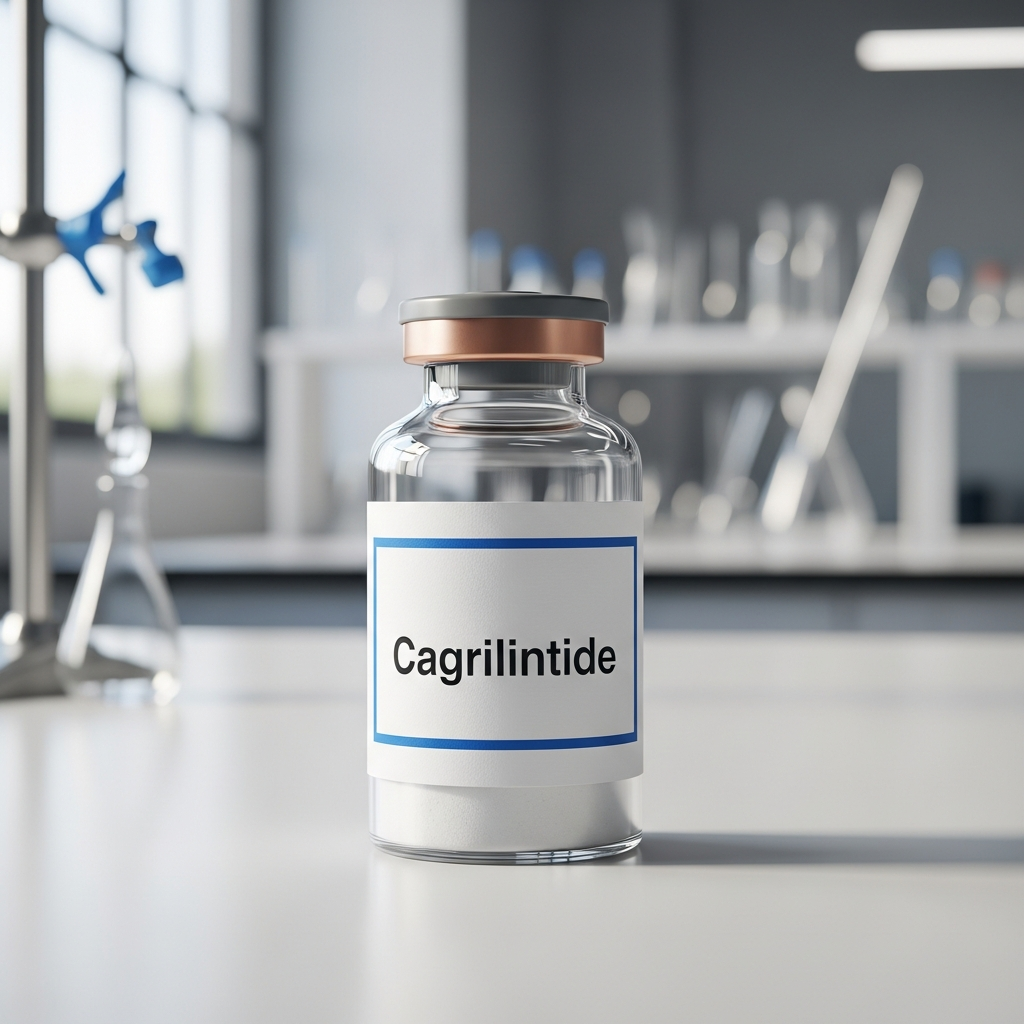
Disclaimer: This article is for educational and informational purposes only. It does not constitute medical advice. All products referenced are intended for research and laboratory use only and are not approved for human consumption.
Cagrilintide has moved from a quiet entry in the metabolic-research pipeline to one of the most discussed compounds of the next-generation GLP-1 era. It is not a GLP-1 agonist at all. It is a long-acting amylin analog that works through a completely separate satiety pathway, and that difference is exactly why research groups keep pairing it with semaglutide instead of replacing it. With phase 3 CagriSema data now published and a regulatory filing on the table, demand for high-purity reference material has surged across the global research community. This guide explains what cagrilintide is, why it matters scientifically, and what to look for when sourcing it for laboratory work.
Key Takeaways
- Cagrilintide is a long-acting acylated amylin analog that activates amylin receptors (AMY1R, AMY2R, AMY3R) and the calcitonin receptor, working through satiety and gastric-emptying pathways rather than the incretin (GLP-1) system.
- Its half-life is approximately 180 hours in research models, supporting once-weekly dosing schedules used in published studies. CAS number 1415456-99-3, molecular weight approximately 4409 Da.
- In the phase 3 REDEFINE 1 trial, the cagrilintide plus semaglutide combination (CagriSema) produced roughly 20.4% mean body-weight reduction at 68 weeks, rising to 22.7% with full adherence.
- Because amylin and GLP-1 act through complementary, non-redundant mechanisms, cagrilintide is the leading candidate for combination research with both incretin and triple-agonist compounds.
- Quality matters: look for third-party HPLC verification, a batch-specific COA, and purity above 99% before any reconstitution work.
- Lyze Labs supplies pharmaceutical-grade cagrilintide for research use only, with free discreet worldwide shipping and per-batch certificates of analysis.
What Cagrilintide Is and How It Works
Cagrilintide, originally designated AM833, is a synthetic analog of human amylin, the hormone co-secreted with insulin by pancreatic beta cells. Native amylin is notoriously unstable and short-lived, which makes it useless as a long-acting research tool. Cagrilintide solves this through N-terminal acylation: a C20 eicosanedioic fatty diacid is attached via a gamma-glutamic acid linker, dramatically extending its presence in circulation to a half-life of roughly 180 hours.
Mechanistically, cagrilintide is a non-selective agonist of the amylin receptor family and the calcitonin receptor. In research models it acts on the area postrema and hypothalamus to influence appetite signaling and satiety. One of its most studied actions is delayed gastric emptying, which in laboratory settings is associated with prolonged fullness signaling and reduced feeding frequency. Cryo-electron microscopy work published in 2025 by groups at Monash University and Novo Nordisk mapped how cagrilintide engages each amylin receptor subtype and the calcitonin receptor in active, Gs-coupled conformations, giving researchers a structural basis for its potency and selectivity.
The critical point for anyone evaluating this compound: cagrilintide operates entirely outside the GLP-1 pathway. It is not an incretin mimetic. That mechanistic separation is the entire scientific rationale behind combining it with GLP-1 compounds, covered below.
Why Researchers Are Interested: The CagriSema Data
The compound that put cagrilintide on the map is CagriSema, the fixed combination of cagrilintide and semaglutide. The phase 3 REDEFINE program delivered the data that drove 2025-2026 interest.
In REDEFINE 1, a 68-week trial in adults with overweight or obesity, the cagrilintide plus semaglutide arm produced approximately 20.4% mean body-weight reduction, compared with 14.9% for semaglutide alone, 11.5% for cagrilintide alone, and 3% for placebo. Accounting for full treatment adherence, the combination figure rose to 22.7%. Around 60% of participants in the combination arm reached at least 20% reduction, and 23% reached 30% or more. REDEFINE 2, conducted in a population with type 2 diabetes, also met its endpoints. Both trials were published in the New England Journal of Medicine in 2025, and Novo Nordisk subsequently filed for regulatory approval of CagriSema as the first once-weekly GLP-1 plus amylin combination.
| Compound | Class | Receptor Targets | Phase 3 Weight Reduction (research models) |
|---|---|---|---|
| Cagrilintide (monotherapy) | Amylin analog | AMY1/2/3R + CTR | ~11.5% |
| Semaglutide | GLP-1 agonist | GLP-1R | ~14.9% |
| CagriSema (cagrilintide + semaglutide) | Amylin + GLP-1 | Amylin + GLP-1R | ~20.4% (22.7% full adherence) |
What makes these numbers compelling to research groups is not just the magnitude but the additivity. Two mechanisms stacked together produced more than either alone, which is the kind of result that reshapes a research program.
How Cagrilintide Compares to Tirzepatide and Retatrutide
The next-generation weight-research field is now defined by how compounds combine receptor targets. Cagrilintide occupies a unique position because it is the only major candidate that does not touch the incretin system at all.
Tirzepatide is a dual agonist of the GLP-1 and GIP receptors, and that dual action is widely credited with its strong performance relative to GLP-1-only compounds. Retatrutide goes further still as a triple agonist hitting GLP-1, GIP, and glucagon receptors, with the added glucagon activation theorized to drive fat oxidation and energy expenditure. For a deeper look at those two, see our retatrutide triple-agonist research guide and our retatrutide vs tirzepatide vs semaglutide comparison.
Cagrilintide is different. It adds the amylin axis, a satiety pathway that is complementary rather than redundant with incretin signaling. That is precisely why the CagriSema combination worked: it stacked two independent appetite-regulation systems. Researchers have extended this logic theoretically toward pairing amylin agonism with triple-agonist compounds, though as of 2026 there is no published clinical trial of a cagrilintide plus retatrutide combination. The strongest direct combination evidence outside of CagriSema comes from preclinical work where cagrilintide and tirzepatide given together at sub-maximal doses produced greater weight reduction in obese rodent models than either compound alone.
| Approach | What it adds | Combination research status |
|---|---|---|
| GLP-1 only (semaglutide) | Incretin satiety | Established |
| GLP-1 + GIP (tirzepatide) | Dual incretin | Established |
| Triple agonist (retatrutide) | + glucagon / energy expenditure | Active research |
| Amylin + GLP-1 (CagriSema) | Separate satiety axis | Phase 3 complete |
The takeaway for sourcing: cagrilintide is not a competitor to the incretin compounds, it is a research partner to them.
What to Look For in a Quality Reference Compound
Because cagrilintide is a complex 4409 Da acylated peptide, manufacturing quality varies enormously across suppliers. Impurities, truncated sequences, and incomplete acylation can all compromise research reproducibility. Before any laboratory uses a batch, three things should be verified.
First, third-party HPLC analysis confirming purity above 99%. High-performance liquid chromatography is the standard for separating and quantifying peptide-related impurities, and a reputable supplier will have this run by an independent lab. Second, a batch-specific certificate of analysis (COA) rather than a generic marketing document. The COA should match the lot number on the vial. Third, mass-spectrometry confirmation of molecular weight against the expected approximately 4409 Da. Our guide on how to verify research peptide purity with a COA walks through reading these documents line by line, and our piece on research peptide scam red flags covers the warning signs of low-grade material. Every batch of cagrilintide from Lyze Labs ships with a per-batch COA and is HPLC tested above 99% purity.
Reconstitution and Storage Notes (Research Framing)
In published research and formulation patents, cagrilintide is most chemically and physically stable in a mildly acidic environment, around pH 3.5 to 4.5. Lyophilized peptide should be kept cold and protected from light and moisture until use; most laboratories store the unreconstituted powder frozen for long-term stability.
For reconstitution in research settings, bacteriostatic water is the conventional diluent, added gently down the side of the vial rather than directly onto the powder to avoid mechanical stress on the peptide. Once reconstituted, the solution is typically refrigerated and used within a defined window. These are general handling notes drawn from peptide-chemistry literature and are provided strictly for laboratory context, not as any usage protocol. For detailed methodology, see our guides on how to reconstitute research peptides and peptide storage and stability.
Sourcing Cagrilintide for Research
Global demand for amylin-pathway research material has accelerated sharply alongside the broader next-generation GLP-1 surge, and high-purity cagrilintide batches move quickly. Lyze Labs supplies pharmaceutical-grade cagrilintide for research and laboratory use only, manufactured to research-grade standards and verified by third-party HPLC at purity above 99%, with a certificate of analysis available for every batch.
We are a neutral global supplier trusted by over 12,000 researchers across more than 50 countries. Shipping is free worldwide with discreet packaging and typical delivery in 7 to 14 days. Ordering is fastest via WhatsApp, and we also accept Visa, Mastercard, UPI, PayPal, CashApp, bank and wire transfer, and crypto including BTC, USDT, and ETH. Given current global demand, securing your batch early locks in present pricing.
Frequently Asked Questions
What is cagrilintide and how does it differ from GLP-1 compounds?
Cagrilintide is a long-acting amylin analog that activates amylin receptors and the calcitonin receptor, influencing satiety and gastric emptying in research models. Unlike semaglutide, tirzepatide, or retatrutide, it does not act on GLP-1 or other incretin receptors at all. This makes it mechanistically complementary to incretin compounds rather than a substitute, which is why researchers pair the two.
Why is cagrilintide combined with semaglutide in CagriSema?
Because amylin and GLP-1 work through separate, non-redundant satiety pathways, combining them stacks two independent appetite-regulation mechanisms. In the phase 3 REDEFINE 1 trial, the combination produced roughly 20.4% mean body-weight reduction at 68 weeks, more than either compound alone. The additive effect is the core scientific rationale behind the combination.
How does cagrilintide compare to retatrutide and tirzepatide?
Tirzepatide is a dual GLP-1/GIP agonist and retatrutide is a triple GLP-1/GIP/glucagon agonist, both working within the incretin system. Cagrilintide adds an entirely separate amylin axis. There is no published clinical trial of cagrilintide combined with retatrutide as of 2026, though preclinical data on cagrilintide plus tirzepatide showed enhanced effects in rodent models. See our tirzepatide dual-agonist guide for more.
What are the key specifications of cagrilintide?
Cagrilintide carries CAS number 1415456-99-3 and a molecular weight of approximately 4409 Da. Its half-life in research models is roughly 180 hours, achieved through C20 fatty-diacid acylation, which supports once-weekly dosing schedules used in studies. It is an investigational compound for research use only and is not approved for human use.
How should research-grade cagrilintide be verified for quality?
Look for third-party HPLC analysis confirming purity above 99%, a batch-specific certificate of analysis matching the vial lot number, and mass-spectrometry confirmation of the expected molecular weight. Generic documents or missing lot matching are warning signs. Every Lyze Labs batch includes a per-batch COA and independent HPLC verification.
Is cagrilintide approved for human use?
No. Cagrilintide is an investigational compound studied in laboratory and clinical research settings, and it is not approved for human use. All material supplied by Lyze Labs is strictly for research and laboratory use only. Nothing in this guide constitutes medical advice or a usage protocol.
Ready to source high-purity reference material? Order cagrilintide directly through the product page or message us on WhatsApp for the fastest response. Every batch ships free worldwide with discreet packaging and a verified certificate of analysis, secure your batch while current pricing holds.
Related Research Guides
Cagrilintide vs Retatrutide: Amylin Analog vs Triple Agonist Compared (2025 Research)
Cagrilintide is a long-acting amylin analog, retatrutide is a GLP-1/GIP/glucagon triple agonist. We compare their mechanisms, half-lives, and 2025 study data side by side for researchers, plus why cagrilintide is studied alongside semaglutide as CagriSema.
Best Peptides for Weight Loss 2026: A Research Guide
A 2026 research roundup of the best weight loss peptides, comparing Retatrutide, Tirzepatide, Semaglutide, Cagrilintide and AOD-9604 by mechanism, study findings and purity standards for laboratory work.

Retatrutide vs Mounjaro vs Ozempic: A Research Comparison of Triple, Dual, and Single Agonists
A research-focused comparison of retatrutide against tirzepatide (Mounjaro) and semaglutide (Ozempic/Wegovy), clarifying which are FDA-approved drugs versus laboratory compounds, and how triple, dual, and single receptor agonism differ at the mechanism level.